Deal management decoded: A practical guide to vendor-funded promotions

Two hands shaking

Table of content

Introduction

Retail promotions don’t run on discounts alone, they often run on vendor funding. Yet for most retailers, deal management; the process of negotiating, tracking, and activating that funding; is held together with spreadsheets, emails, and manual work. The result is lost revenue, eroded margins, and conflicts.

This guide is for the teams on both sides of that relationship who want to close this gap. It walks through the end-to-end deal management process, from the moment a vendor proposes a funding agreement, to the moment a shopper picks a discounted product off the shelf.
This is deal management made simple.

What is deal management?

Deal management is the process of capturing, tracking, and reconciling the funding that vendors provide to support a business, ensuring every dollar is accounted for, correctly applied, and tied to the agreement it was intended to support.

Vendor deals fall into two categories:

  • Non-promotional deals which run quietly in the background, but still require careful management to ensure the agreed-upon terms are respected and margins are protected.
  • Promotional deals which are explicitly tied to a specific offer, campaign, or activity. These deals represent a vendor’s direct investment in a promotion or advertisement. Managing them well means the right funding is applied to the right promotion, on time.


Good deal management ensures that all terms and conditions are fulfilled and that the agreed-upon pricing is profitable and competitive. For companies that offer customized projects or configured items, efficient deal management is essential because it meets client needs and delivers high customer value while optimizing pricing and profitability for the seller. When done correctly, deal management benefits both buyers and sellers.

Poor deal management, on the other hand, leads to missed funding, misapplied discounts and promotions that cost more than they return. That’s why having a clear, and structured process is crucial.

Key concepts in deal management

What is vendor collaboration?

Vendor collaboration is the structured process by which retailers and vendors work together to plan, fund, and execute promotions across the different channels (In-store, online, digital offers such as coupons,etc..). Mainly, it is a financial and operational partnership built around a simple exchange, and it’s the core of deal management.

  • The vendor provides funding to support a price reduction or promotional activity.
  • The retailer decides how to execute that promotion, what to discount, when, where, and how.
  • Both parties align on the products covered, the time period, and the financial terms.

When it works well, both sides win. Vendors get measurable sales lift and brand visibility. Retailers increase volume and protect margin. Shoppers get a better deal.

What is vendor funding?

Vendor funding refers to financial support from vendors for retail promotions, and it plays a crucial role in effective deal management. For instance:

  • A retailer reduces prices on products in-store.
  • The vendor compensates for a portion of the discount.
  • Funding is linked to specific products, timelines, and defined responsibilities (e.g., $1 reimbursement per unit sold for a coffee product in March across all stores).

Main funding types in deal management
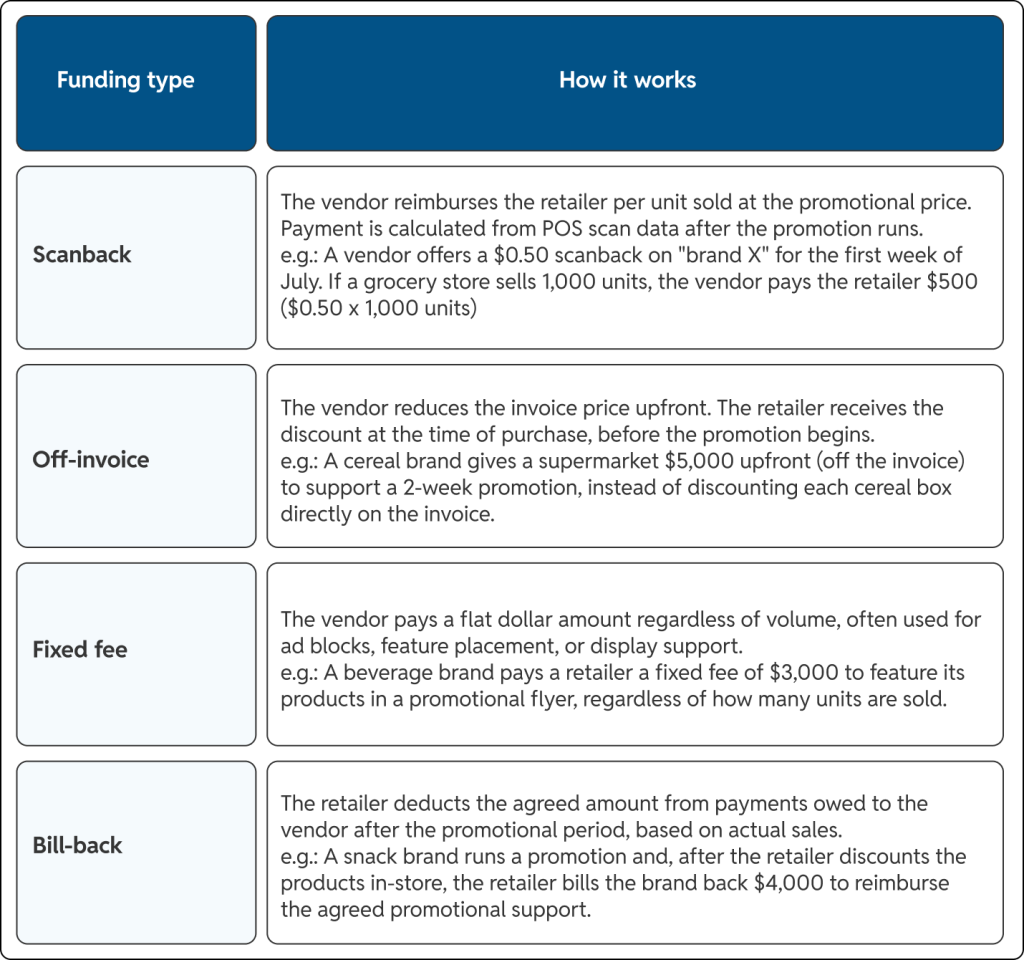
 

Main funding types in deal management


Common challenges in traditional deal management

Traditional deal management frequently depends on spreadsheets, emails, and disconnected systems, which results in inefficiencies. Here’s a breakdown of the main pain points that hold deal management back: 

  • Fragmented planning: Funding agreements and joint business plans are managed outside of core systems, which increases the chance of errors and slows alignment.
  • Manual processes: Spreadsheets are exchanged multiple times per season: sent to vendors, returned, reconciled, adjusted, and redistributed.
  • Disconnected funding: Funding decisions are isolated from promotion planning, making it hard to track how funds lead to executed deals or results.
  • Difficult adjustments: Plan changes require manual updates via email and spreadsheets, a slow, error-prone method that hampers responsiveness.

These issues signal weak deal management, and fixing them requires a unified workspace and process.
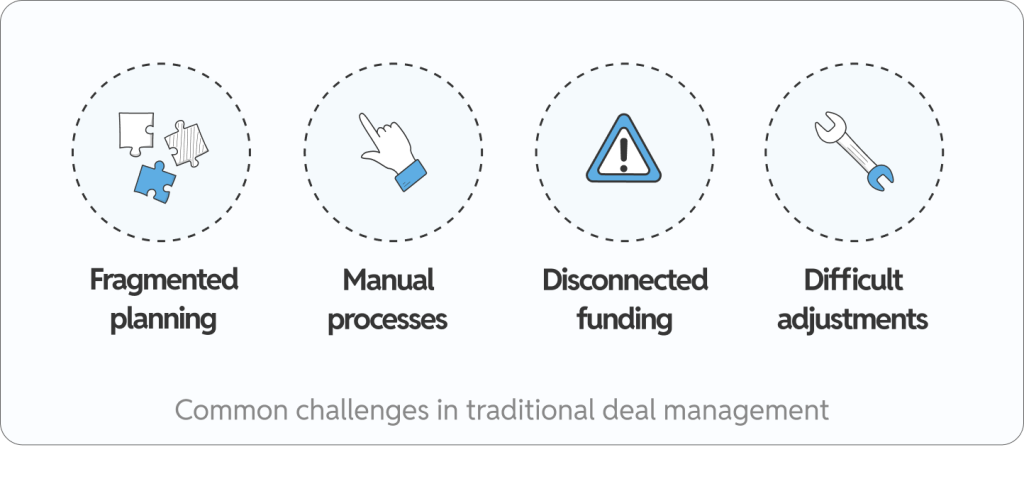
Common challenges in traditional deal management

The importance of optimized deal management

Retail promotions are driven by targeted vendor funding and go beyond simple discounts. While a large part of in-store promotions is funded by suppliers, studies show that up to 80% of those promotional budgets fail to drive growth. In other words, without careful coordination between retailers and vendors and structured deal management, much of this spending can be wasted.

This is where smart, modern deal management solutions make the difference:

  • A single platform for handling financial responsibilities and coordinating strategies.
  • Tools for planning ahead and making changes in real time.
  • Effective procedures for approval and negotiation.
  • Centralized workspace between events, promotions, and finance.

Vendors attain measurable outcomes, retailers boost sales, all while protecting margins. Money may be left on the table without this kind of coordination, which gives you a solid basis for success.

The retailer-vendor partnership: How deals actually work

A strong partnership turns funding into measurable, strong promotions. Below is the step-by-step flow of structured deal management, from both perspectives at each stage.

The anatomy of a well-managed deal 

  • Fund proposal: The vendor defines their investment: which products, funding type, and timing. Terms are clear so the retailer can respond quickly.
  • Retailer review: The retailer can evaluate the fund based on their calendar, counter-propose, request changes, or even suggest preferred activation. 
  • Negotiation: Changes are tracked, with comments and historical records. Both sides can see the full history in one thread. 
  • Approval: Agreed terms get approved, making the fund ready to activate along with specific promotions.
  • Execution: The promotion runs in-store, sales data is recorded, and applied funding is tracked in real time.
  • Settlement: Sales are measured, agreed payments(scanback, off-invoice..) are validated and settled.
  • Performance visibility: Both sides can see what the promotion generated: total sales, and total funding applied. Post-promotion review becomes simple, and the data is used for future promos ( what worked, what didn’t..)

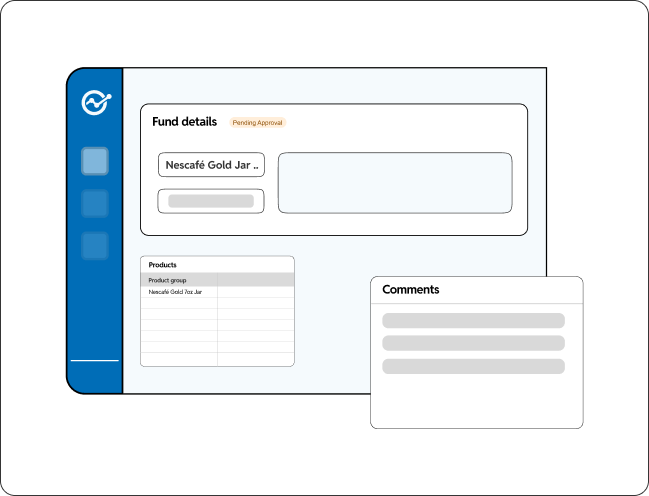
The anatomy of a well-managed deal: process flow

  The vendor’s perspective

Vendors who approach deal management strategically do several things differently from those who treat it as an administrative obligation.

  • Propose with precision: 

Winning vendors submit funding agreements with specific details: clear product scope, defined contribution rates, precise timelines. Unclear proposals cause slow approvals, while structured proposals make it easy for the retailer to move forward.

  • Stay close to execution:

Between agreement and in-store execution, a lot can change. Product groups get updated, offers get modified, etc.. Smart vendors track what happens to their funding after approval, and engage quickly when something goes wrong, or drifts from the agreed terms.

  • Measure what matters:

Funding investment should be evaluated against outcomes: sales lift, incremental volume, etc.. Vendors who stay up to this standard, and who can demonstrate ROI from their deal making, become preferred partners in future deal management and planning cycles.

The competitive advantage
Vendors who manage deals with precision don’t just run better promotions, they build a track record that earns them better placement, better planning, and a strong voice in future negotiations.

  The retailer’s perspective 

Retailers hold a crucial position in the vendor-retailer relationship: they control the shelf, the promotional calendar, and the shopping touchpoints. With that advantage comes a set of obligations that, when respected, the overall deal management process becomes more effective.

  • Activate funding as agreed: 

The most important obligation is the most obvious: if a vendor has set a funding for a specific product, period, and store set, the retailer should go for a promotion that respects those terms. Funding that is approved but never used properly, erodes trust and impacts future partnerships.

  • Give vendors visibility into execution:

Vendors should see how their fundings are being used. High-performing retailers give vendors meaningful visibility into how their funds are linked to promotions, a clear view from deal to discount to in-store execution.

  • Set clear expectations before running the promotion:

When target funding is specified before launching a promotion, both sides know what success looks like, and exceptions are caught before they become conflicts.

  • Respond to vendors not just their money: 

The vendor-retailer relationship is not just a billing relationship, it’s a planning partnership. Retailers who engage with vendor input, respond to fund proposals promptly, and explain their reasoning when they counter-propose consistently attract higher quality deal terms.

The competitive advantage
The retailer who treats vendor funding as a partnership worth protecting, succeeds to get better investment offers, and attract more strategic deals.

Why vendor-retailer partnerships matter: A research


A study on supplier collaboration and partnership (Cooper,2024) identified the main pillars that separate high-performing partnerships from transactional ones. Each maps directly to the vendor-retailer dynamic and strong deal management.


  • Collaboration Drives better outcomes than negotiation alone: The research highlights the difference between transactional relationships and true partnerships. For vendors and retailers, this means that every deal should be considered a shared investment in a measurable outcome not just a transaction.
  • Resilience is built deal by deal: One of the article’s key findings is that businesses with good supplier partnerships have stronger ability to handle conflicts. In retail, the partnerships that survive those highs and lows are the ones built on consistent processes and mutual accountability. 
  • Communication prevents losses: In retail promotions, misalignment is expensive. A funding agreement missed, or a promotion launched on the wrong products,.. These are all communication failures. Retailers and vendors who agree on clear, shared communication channels during the whole deal management cycle, are the ones who win.

This article reinforces what high-performing vendors and retailers already know : the quality of the partnership determines the quality of the outcome. Deal management is the backbone for that relationship. When both sides collaborate within a structured, transparent process they run promotions more efficiently.

Platform showcasing funding collaboration

Instead of the old model, where vendors submit budgets, retailers approve, and promotions are built afterward, high-performing businesses plan together from the start. 

Key takeaways: The deal management checklist 

Strong deal management has a clear flow: propose -> review -> negotiate -> approve -> execute -> settle -> learn
When both sides collaborate within a shared workspace, following a shared process, funding turns into measurable growth.

What makes deal management work:

  • Precision upfront: Clear proposals and defined timelines make approvals faster.
  • Shared visibility: Funding and promotions are linked from start to finish.
  • Structured execution: Promotions run as agreed, with real time tracking.
  • Measured impact: Every deal data is evaluated and used to improve next ones.

What a winning deal management platform looks like 

Businesses that manage vendor-funded promotions well, share a few key practices that set them apart. These principles require alignment and the right workspace to ensure effective deal management.

One shared record of truth 

The most critical part of high-performing deal management is that both the vendor and the retailer share the same information. Not emailed updates, but a shared live record. 

When both sides see the same fund status, the same agreed terms, and the same linked promotions, misalignment becomes a myth. Approval cycles become faster, because both sides can review and respond in real time.
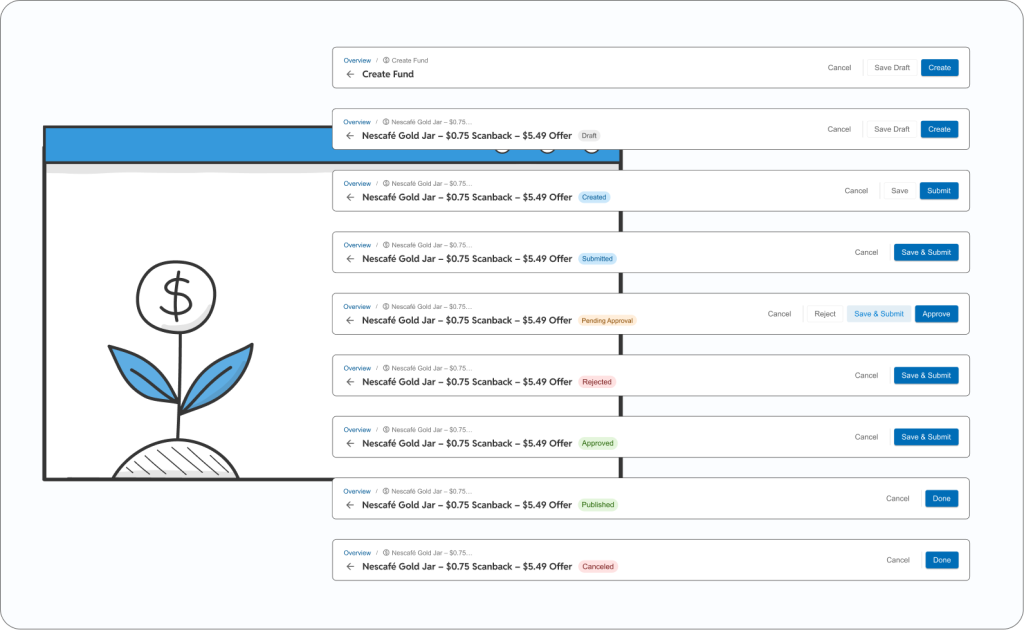
What a winning deal management platform looks like

Plan collaboratively, not sequentially

Vendors and retailers align on promotional objectives, calendar priorities, and funding levels before formal proposals are submitted. Joint business planning is a core principle of winning deal management. 

Link funding and promotions

In winning businesses, the question “is this promotion funded?”  is answered before the promotion is built, not after it runs. Funding and execution are planned together, not in sequence.

This means:   

  • Retailers creating a promotion can see available vendor funding and agreed terms from the start.
  • Vendors can track how their funding is being used, which promotions it’s linked to, what offers are available, and whether it meets the agreed requirements.


Clear roles and responsibilities

The best deal management processes do not rely on manual follow ups. Accountability is built into the workflow itself.

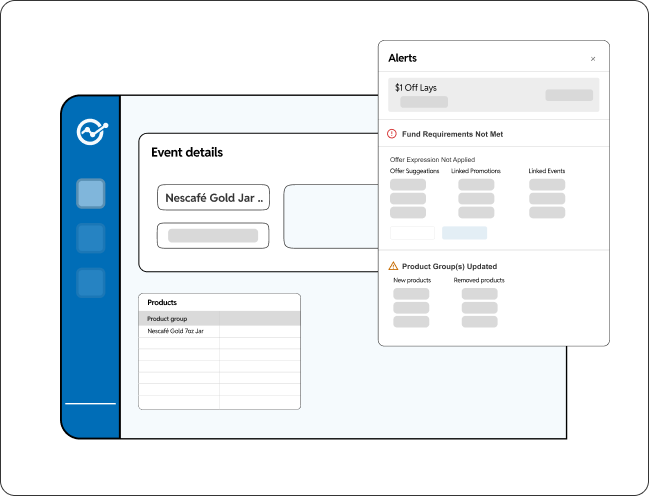
  • Alerts trigger automatically if funding isn’t confirmed, falls below targets, or if changes affect an active fund. Everyone stays informed in real time.
  • A mature deal management software helps spot issues before they become costly. Waiting until a promotion ends to discover funding gaps is already too late to act.

Structured records of negotiations

 Deal management is basically a negotiation. Terms are suggested, changed, and agreed on. What sets successful businesses apart is that every step is tracked.

  • Every change related to a fund (who made it, what was changed..) is recorded and visible to both sides. 
  • Notes, comments and context stay in one place  instead of getting lost in email threads. 

This transparency also builds trust. Vendors who see their funding used as agreed become better partners, and retailers that show clear processes and follow-ups attract more investment.

Learn from every deal

High-performing businesses treat promotion performance data as a strategic asset.

Comparing promotions, what drove lift at $1 vs. $0.75$ scanbacks for example, provides structure for smarter decisions in future negotiations. Each deal becomes a learning opportunity to continuously optimize promotions, funding, planning, and execution.

Key takeaways: Strong deal management principles

  • One shared source of truth: Vendors and retailers operate from the same live data, eliminating version conflicts, email back-and-forth, and approval delays.
  • Planning before execution: Funding, objectives, and promotional calendars are aligned upfront, not retrofitted after promotions are built.
  • Funding linked to execution: Every promotion is tied to confirmed funding from the start, reducing leakage and protecting margin.
  • Built-in accountability: Clear roles, automated alerts, and workflow-driven approvals replace manual follow-ups and last-minute surprises.
  • Transparent negotiation history: Every change, comment, and adjustment is tracked in one place, reducing disputes and strengthening trust.
  • Performance-driven learning: Deal results are measured, compared, and reused to improve future deal management negotiations and maximize ROI.

Conclusion

Deal management is more than a simple process, it’s a strategic and competitive advantage.. Businesses that do it well, don’t just save time. They build stronger vendor relationships, secure better deal terms, optimize investments, and deliver higher-quality promotions.

The retailers and vendors who win at this follow a clear set of rules. They plan together, negotiate transparently, link funding to execution, and they learn from every cycle. Funding is not the hard part, it’s connecting funding to execution though the whole deal management cycle.

Improve your deal management with PromoAI. Discover how we help retailers and vendors build seamless relationships, collaborate in one unified workspace and drive the best outcomes for both sides through smarter, modern deal management. 

Ready to learn more about PromoAI?

Our team of experts are happy to discuss your business’s needs and show how PromoAI can help you achieve your goals.

Download this guide?