
Promotion planning is one of the most demanding jobs in retail. It spans merchandising, forecasting, finance, vendor funding, and cross-functional approvals, all at once, all on a deadline. Cora is designed specifically for that environment. This guide explains what Cora is, how she works, and what she makes possible for the retailers who use her.
What is Cora?
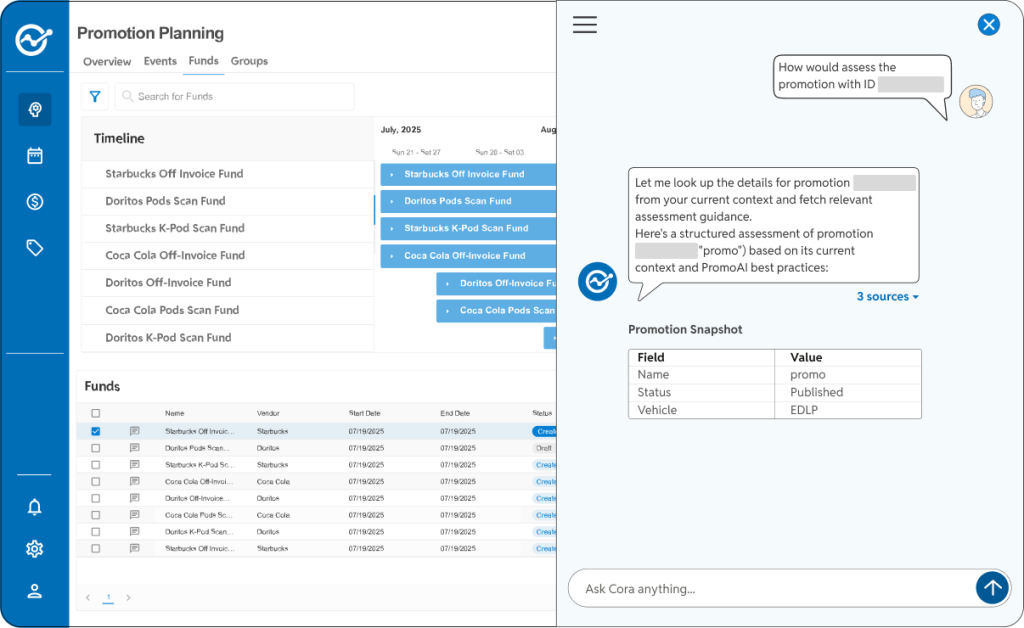
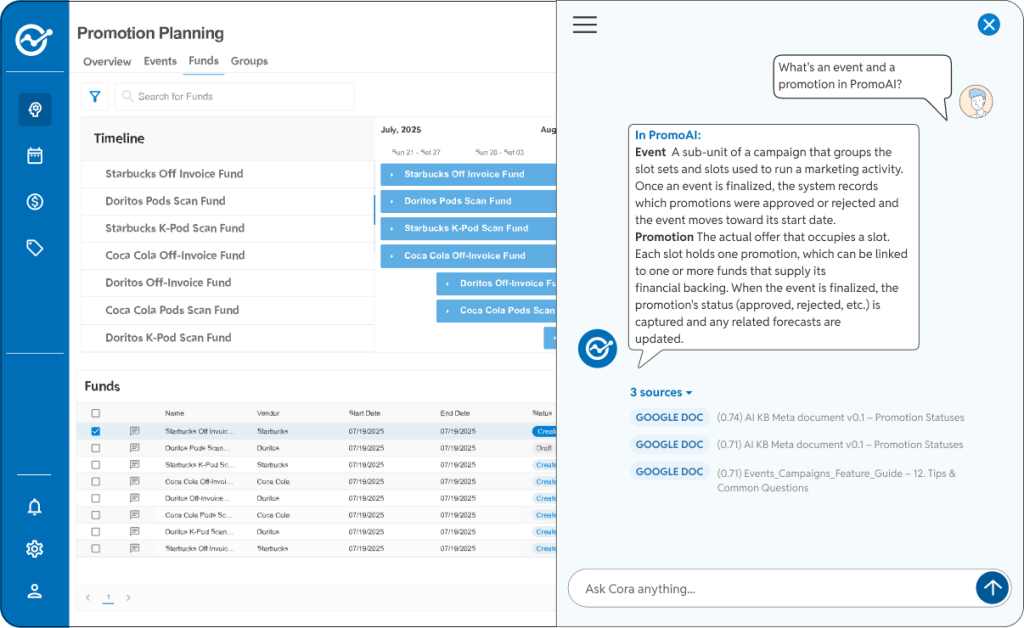
Cora is Cognira’s AI agent embedded within PromoAI, the enterprise promotion planning platform. She serves as the intelligent interface for retail planning teams to interact with forecasting, optimization, analytics, vendor funding, and execution capabilities.
Unlike general AI assistants with broad retail knowledge, Cora operates directly inside your live planning environment. She has full access to your active campaigns, historical performance, vendor funding structures, forecast variances, and organizational workflows.
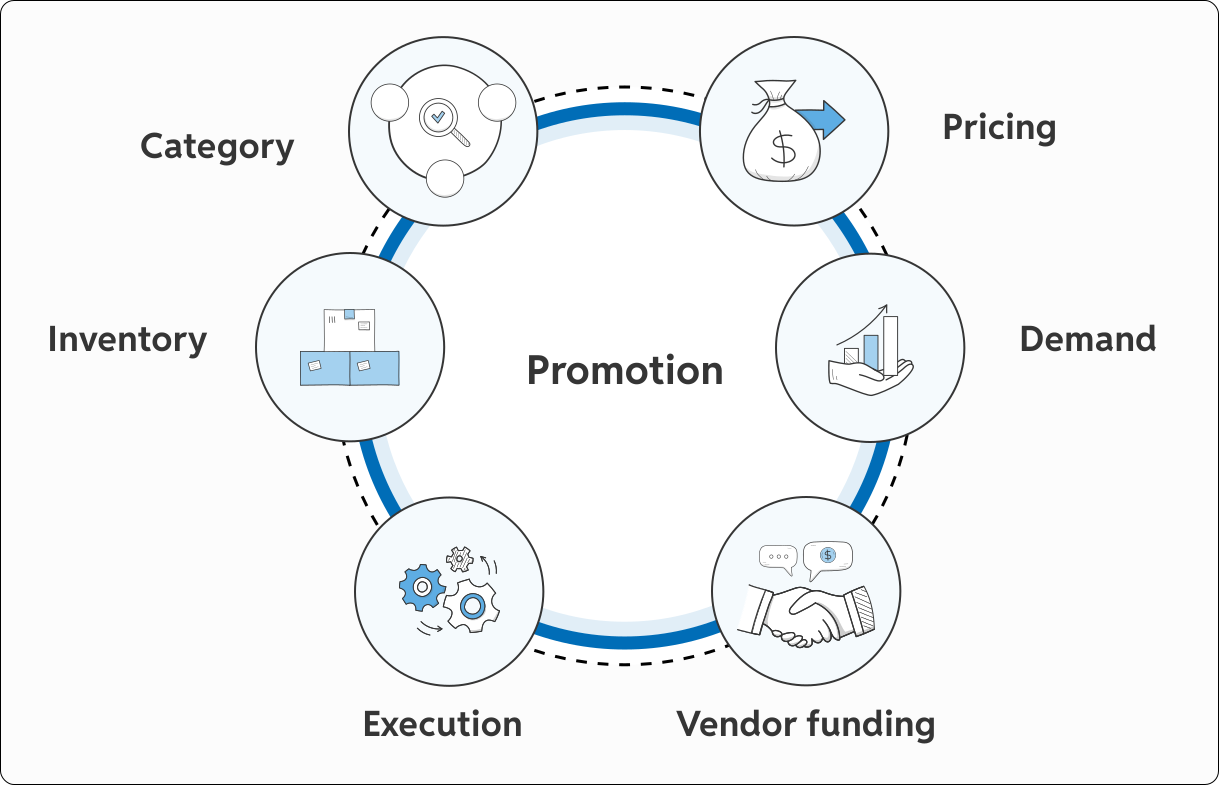
Promotion planning is uniquely difficult because it simultaneously crosses functional boundaries, including category management, demand forecasting, inventory positioning, pricing alignment, vendor funding, and finance approvals. Traditional tools cannot manage or reason across this complete picture.
Cora solves this coordination problem by connecting decisions, surfacing conflicts, and supporting human judgment where AI creates the most practical value.
PromoAI: Promotion management solution for retail
Cora is Cognira’s AI agent embedded within PromoAI, the enterprise promotion planning platform. She serves as the intelligent interface for retail planning teams to interact with forecasting, optimization, analytics, vendor funding, and execution capabilities.
Unlike general AI assistants with broad retail knowledge, Cora operates directly inside your live planning environment. She has full access to your active campaigns, historical performance, vendor funding structures, forecast variances, and organizational workflows.
Promotion planning is uniquely difficult because it simultaneously crosses functional boundaries, including category management, demand forecasting, inventory positioning, pricing alignment, vendor funding, and finance approvals. Traditional tools cannot manage or reason across this complete picture.
Cora solves this coordination problem by connecting decisions, surfacing conflicts, and supporting human judgment where AI creates the most practical value.
Why promotion planning needs an AI agent?
Most enterprise software, including promotion management software, is designed around structured inputs and structured outputs. When you enter a plan, the system generates a forecast. You run an analysis, the system returns a report. The intelligence in those systems is real and valuable, but it does not reach across the planning environment to surface connections, flag conflicts, or help a planner understand what a set of numbers actually means for their next decision.
Such cross-functional pressure is an inherent part of promotion planning. For instance, when designing an event for a beverage category, a category manager must simultaneously establish demand expectations for supply chain execution, set price points for pricing team alignment, use vendor funding monitored by trade finance, and generate a long-term forecast that will guide replenishment decisions weeks down the line.
The environments where AI agents create the most value are precisely those with high decision volume, cross-functional dependencies, and a constant need to reconcile new information against existing plans.
Generic AI assistants cannot operate in this kind of environment because they lack the context. They do not know what your promotional calendar looks like, what your vendor funding agreements contain, or why your forecast for a given SKU changed between Monday and Thursday. Cora does, because she is built inside the system where that information lives.
How Cora works inside PromoAI
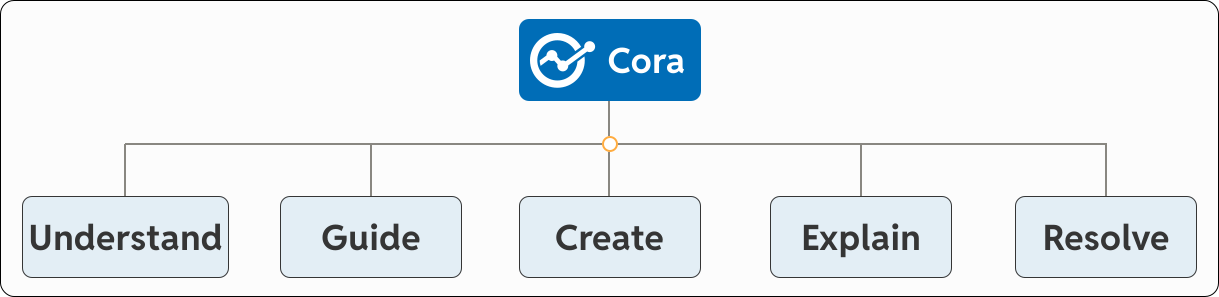
Cora’s capabilities are organized around five actions that cover the full span of what a promotion planner needs from an intelligent assistant: understanding context, receiving guidance, creating content, explaining outputs, and resolving conflicts. Together, these five capabilities make up Cora’s operating model inside PromoAI.
Understand
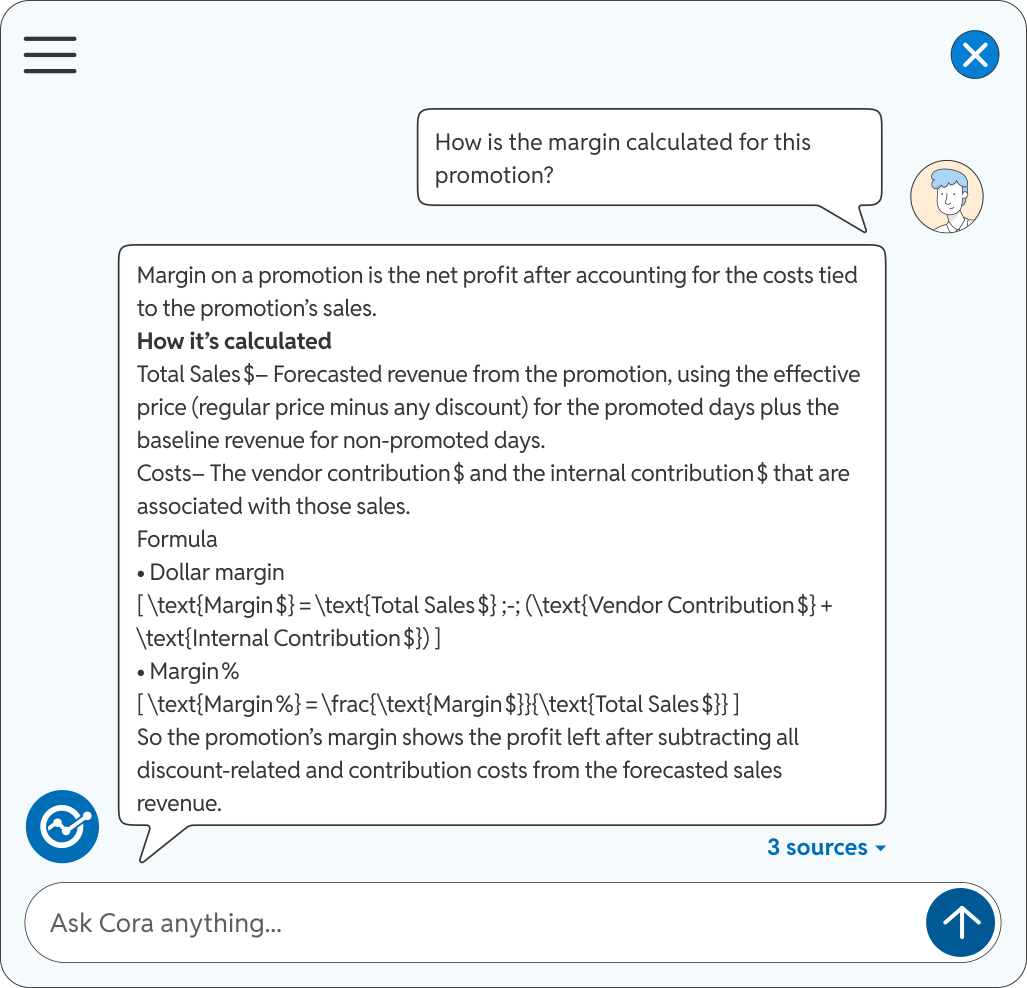
Navigating complex promotion planning systems without clear operational documentation often forces planners to sift through files, interrupt colleagues, or guess when routine questions arise regarding margin calculations, vendor funding, or field meanings.
Cora provides a more efficient alternative by delivering direct, plain-language answers right within the active workflow. This fastens the learning curve for new team members while eliminating lookups and disruptions for experienced planners.
Guide
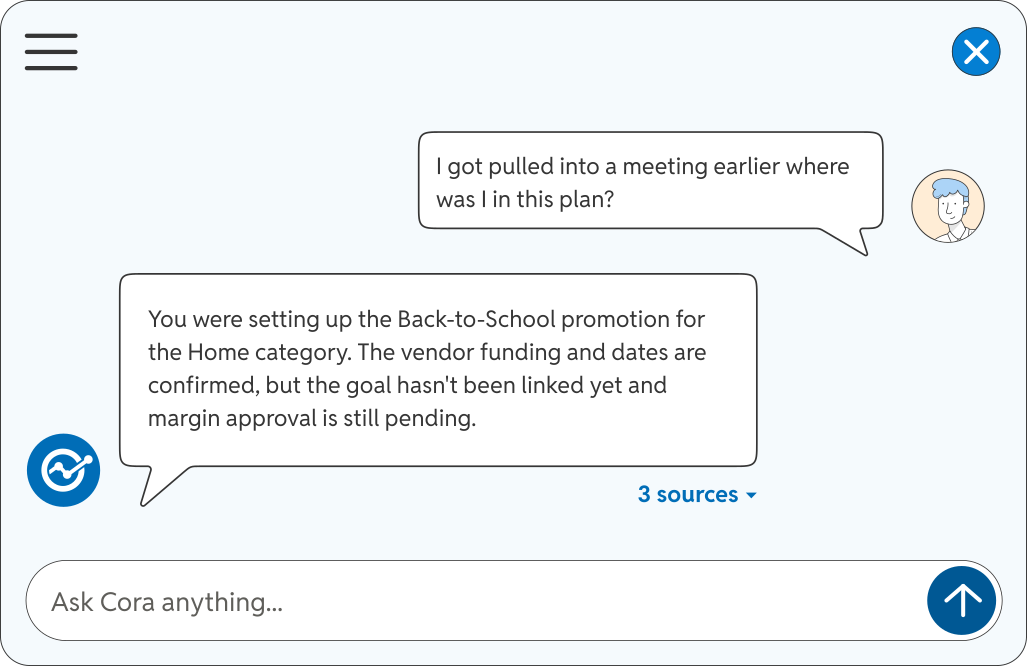
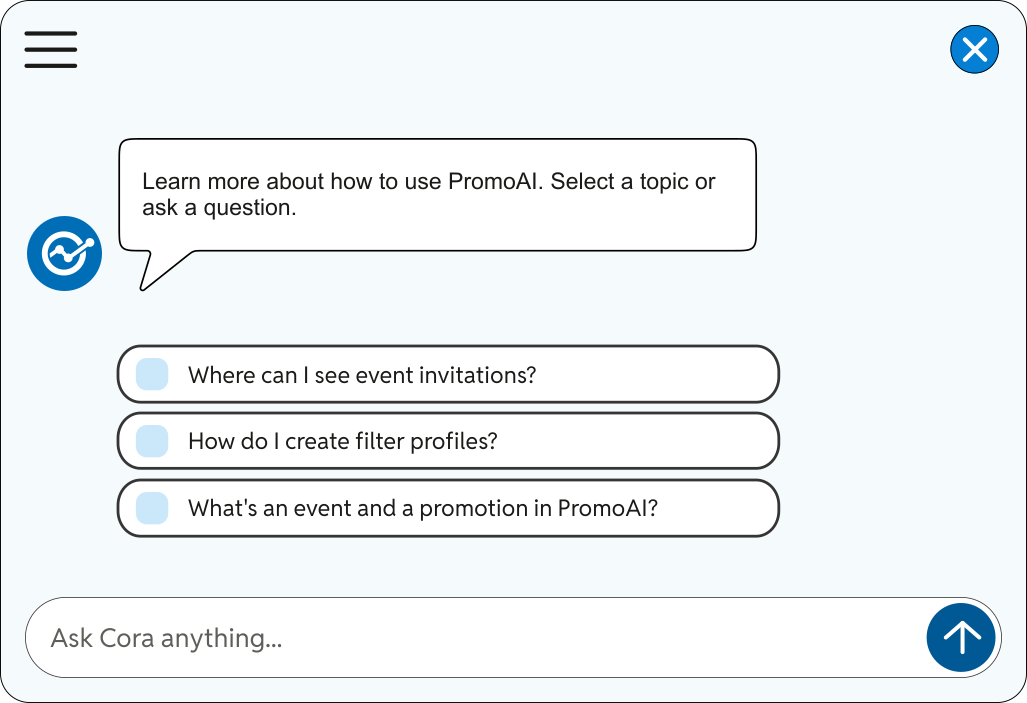
Navigating complex systems is challenging, but Cora simplifies it by interpreting user intent and suggesting logical next steps based on the current context.
Whether routing to goals or resuming tasks, she seamlessly guides planners back to where they left off, minimizing system navigation time so they can focus on strategic, human-judgment decisions.
Create
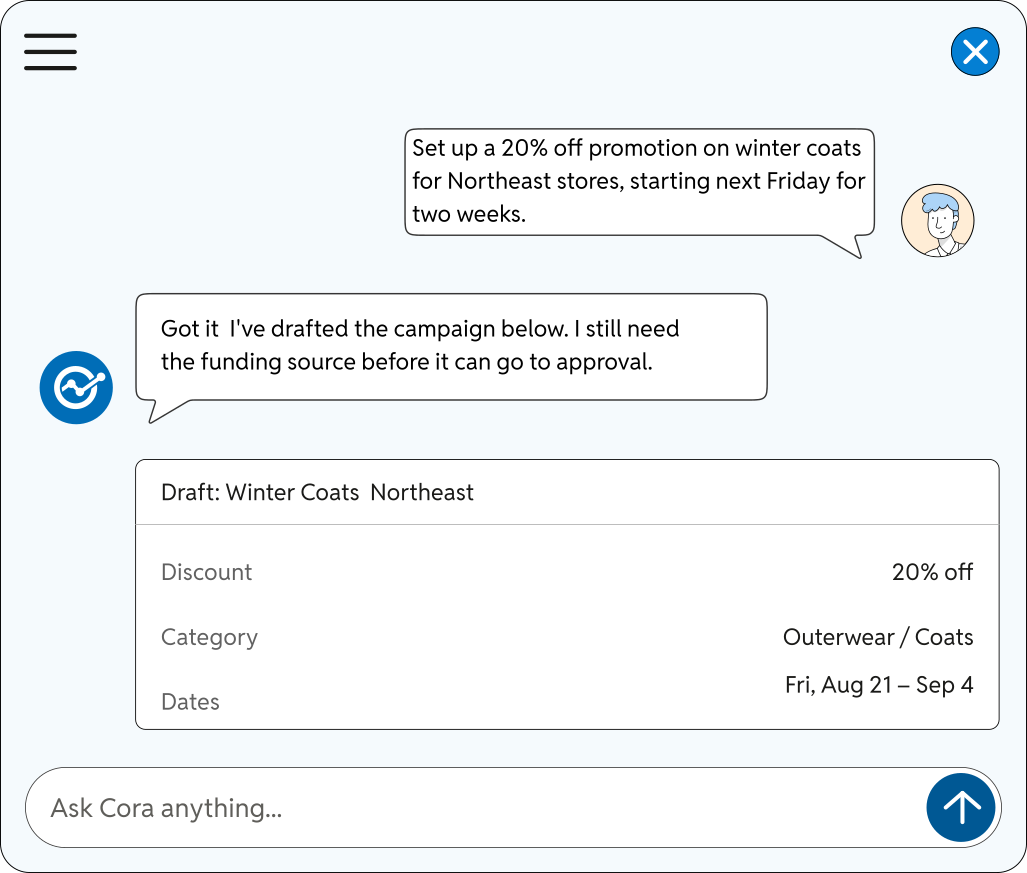
Building promotions in PromoAI traditionally requires labor-intensive data entry across multiple interfaces.
Cora streamlines this by allowing planners to state objectives in natural language, automatically drafting campaigns or prompting for missing details step by step.
By reducing administrative overhead instead of replacing human expertise, this approach enables planners to focus on strategic decisions over routine data entry, delivering targeted retail automation value.
Explain
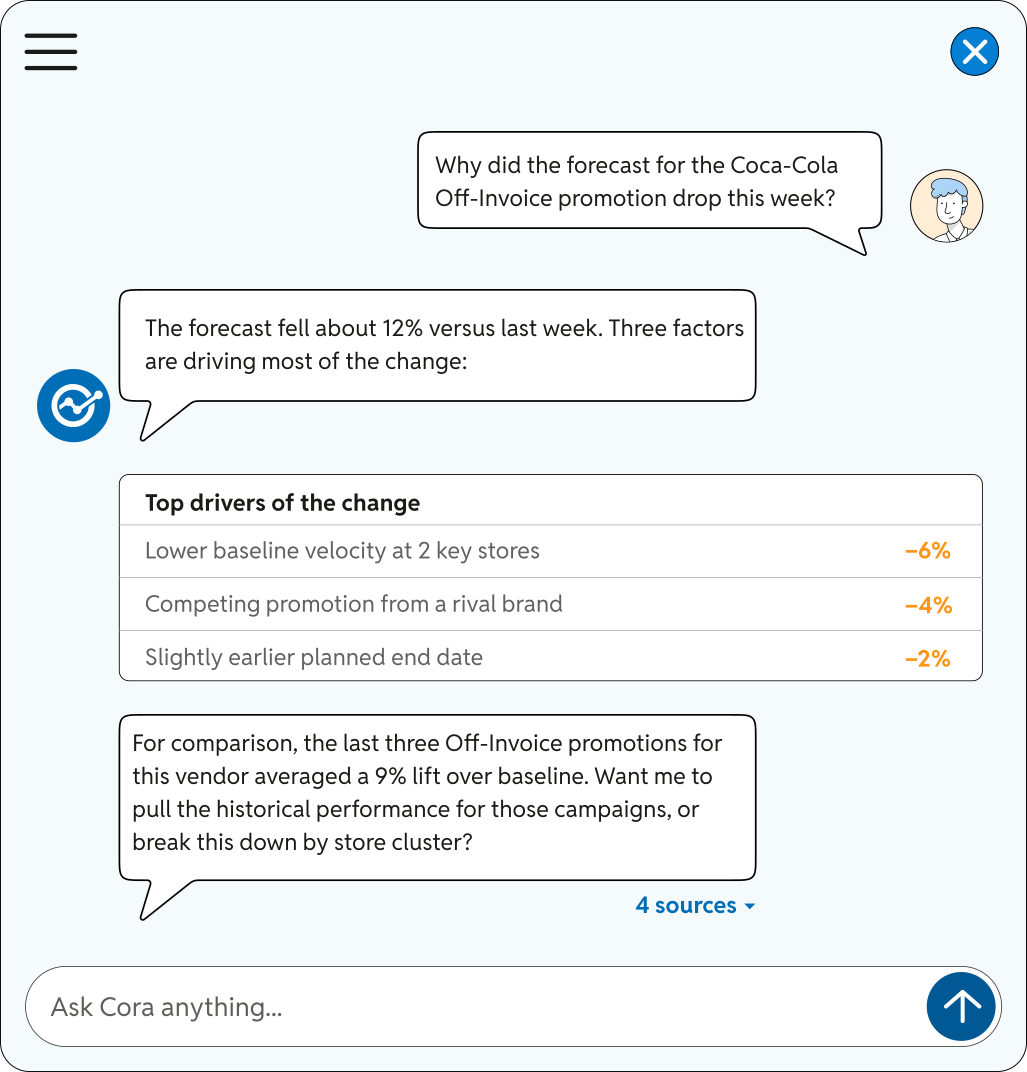
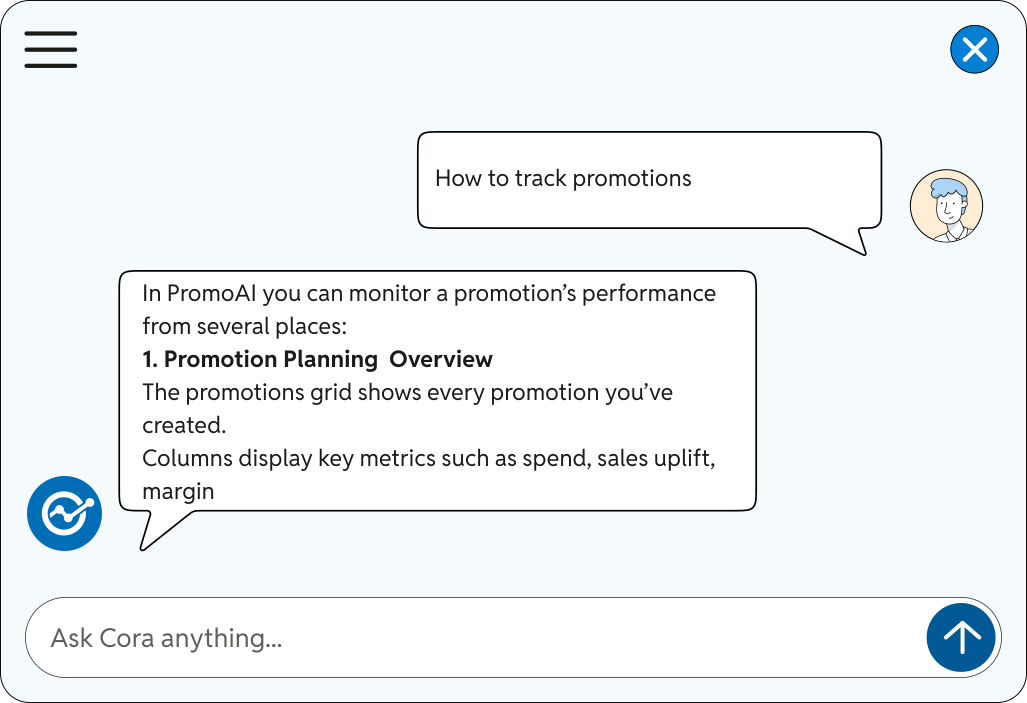
Cora makes analytical insights accessible by translating complex data into plain-language explanations and answering follow-up queries, helping users understand performance drivers and upcoming decisions.
Since promotion planning requires uncovering the narrative behind analytics, planners must frequently investigate why a specific promotional forecast developed, review past campaigns, or identify top historical offer types.
Ultimately, whether evaluating forecasts, historical metrics, or macro trends, the objective remains identical: accelerating the transition from raw data to actionable understanding for planners.
Resolve
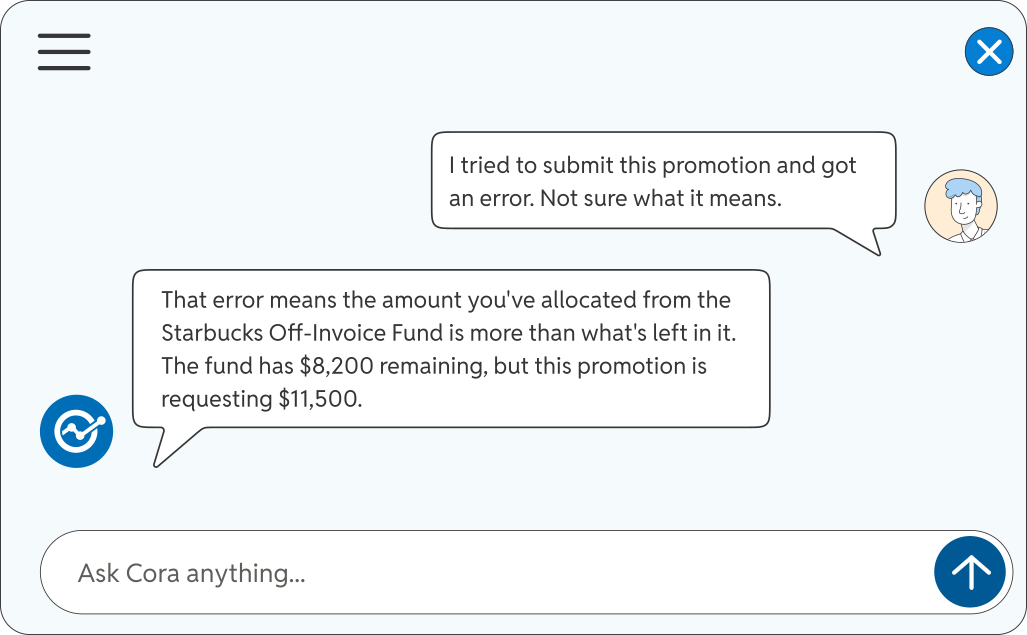
Promotion planning is rarely straightforward, as missing details, unexpected warnings, and backtracking often cause frustration due to ambiguity over how to proceed.
Cora helps users navigate these issues by pinpointing missing information, interpreting complex error messages, and recommending specific actions to keep the workflow moving. Instead of leaving planners to decode system feedback alone, she turns friction into a clear path forward.
A new way to work with PromoAI
Cora does not just add a chat window to PromoAI. She changes the way retail planning teams interact with the platform, and, more broadly, with their promotion data.
This shift from navigation to conversation has a non-trivial effect on how planning work actually gets done.
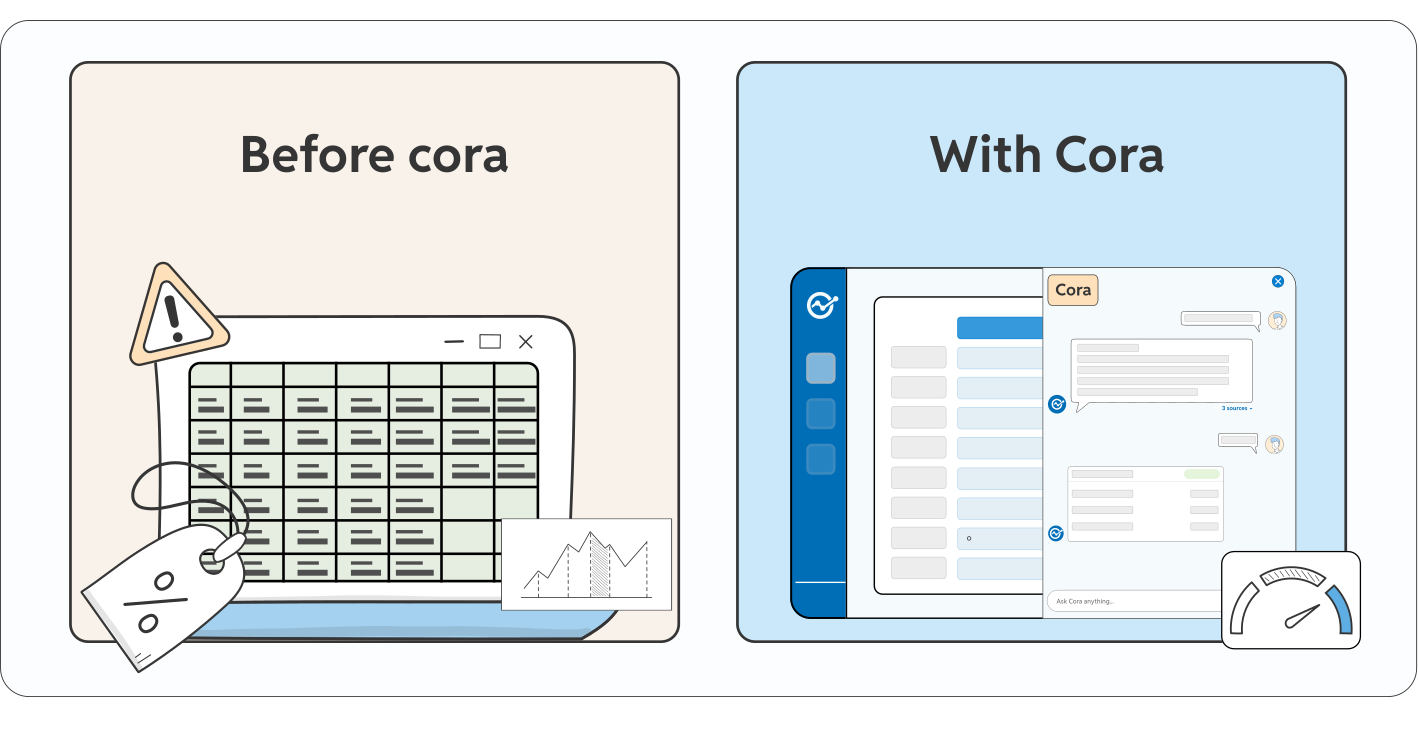
Exploratory questions become easier to ask
Custom queries like comparing regional performance require tedious report building, causing useful insights to go unpursued. Cora makes exploration effortless and fluid, allowing planners to ask conversational questions and immediate follow-ups so they can focus on data interpretation.
From analysis to action within the same workflow
Traditional planning creates friction when transitioning from system analysis to separate execution steps. Cora connects these phases across PromoAI modules, enabling users to investigate variations and draft updated configurations directly within one continuous workflow.

Conversational analytics and forecast navigation
Understanding demand forecasts is crucial yet frustrating in promotion planning due to complex inputs like promotional lift, baselines, and cannibalization. Identifying forecast drivers traditionally required deep model expertise or analyst support.
Cora makes forecast navigation conversational, allowing planners to naturally query numbers, test assumptions, and compare cycles. Rather than replacing PromoAI models, she makes them accessible. to the people who need to act on them.
How Cora makes PromoAI more powerful
Cora is the intelligent interface for PromoAI, not a standalone product. PromoAI provides robust retail planning capabilities, including demand forecasting, promotion optimization, trade analytics, and vendor funding, built from deep data science. Rather than adding new analytics, Cora reduces friction, making these advanced features accessible to all team members, not just power users. Consequently, category managers, trade marketers, and directors can quickly get answers to complex questions directly without waiting for reports or swapping module views, lowering the barrier to platform adoption across the organization.
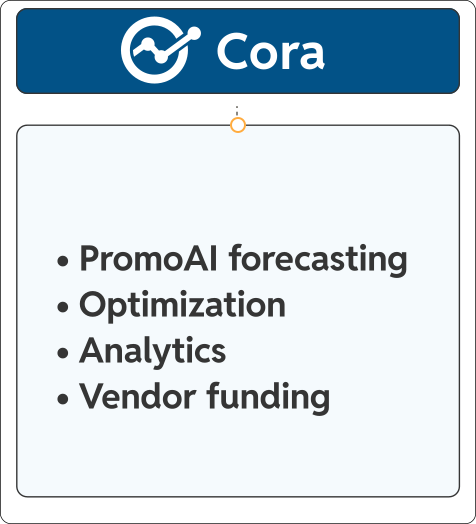
PromoAI: Promotion management solution for retail
Cora is Cognira’s AI agent for promotion planning. But promotion planning does not happen in isolation from the rest of a retail business, and the future of enterprise AI in retail is not a single agent doing everything. It is multiple specialized agents, each with deep expertise in their domain, working together to support decisions that cross application boundaries.
Understanding how that works, and why it matters, requires looking at a specific kind of retail problem: one where the decision involves expertise from multiple domains simultaneously.
The future of AI in retail: Cora in a broader enterprise ecosystem
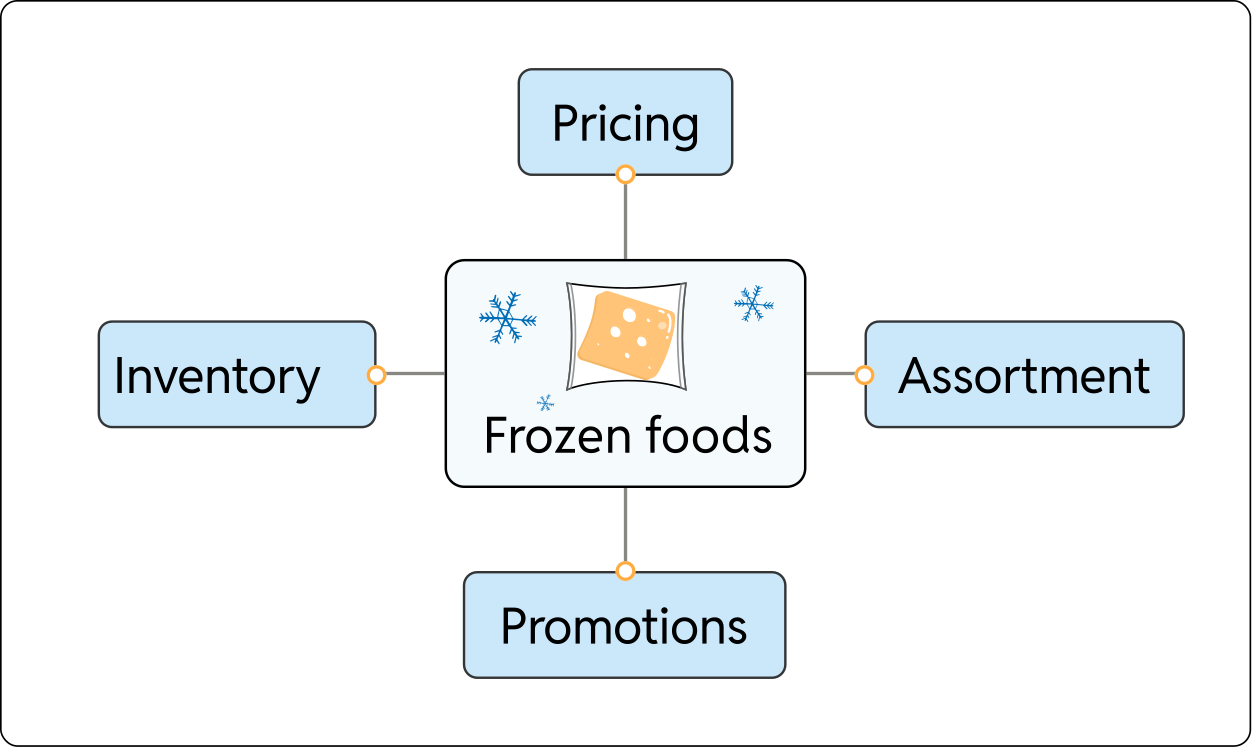
Consider a frozen foods category during a complex planning period. The category is planning a major promotional event, Cora, operating inside PromoAI, can model the demand forecast, evaluate the vendor funding economics, and help the planning team configure the event correctly. But the full context of that promotion extends beyond PromoAI’s boundaries.
The pricing team, working in a separate pricing system, may be tracking competitive price pressure in the frozen foods category that the promotion plan does not yet reflect. The supply chain team may have visibility into a supplier capacity constraint that will affect available inventory during the event window. The assortment team may have made a recent range change that affects which SKUs are eligible for the promotion and which carry sufficient velocity to justify the trade spend.
None of these systems talk to each other natively. Under the current model, surfacing all of that context for a single planning decision requires human coordination across multiple teams, conversations, emails, manual data pulls, and a meeting where someone reconciles the information into a coherent picture. That process is slow, and it often produces decisions that are correct as of the moment they were made but already partially outdated by the time they are executed.
The emerging architecture for enterprise AI in retail introduces a different model: specialized AI agents, each with expertise in their own domain, that can collaborate on cross-domain decisions through an orchestrating layer.
In the frozen foods example, that might look like this:
A pricing agent
Operating in the pricing system, surfaces the competitive context: a major competitor has discounted a key SKU in the category, which affects the optimal promotional depth for the planned event.
A supply chain agent
Operating in the fulfillment system, flags the supplier constraint: available inventory for the primary promoted SKU is constrained during the event window, which changes the risk profile of the planned volume commitment.
An assortment agent
Operating in the range management system, identifies the recent range change: one of the originally planned promotional SKUs has been delisted, and the promotional configuration needs to be updated.
Cora
Operating in PromoAI, understands the promotional plan, the forecast implications, and the vendor funding structure, and can incorporate the inputs from the other agents to produce a coherent updated plan that reflects the full picture.
The orchestrator
The layer that coordinates the exchange between these agents, determines when to ask each agent for input, how to resolve conflicts between their recommendations, and how to present a unified output to the human team that needs to make the final decision.
AI agents: What to look for
Evaluating agentic AI platforms requires a different lens than evaluating traditional software. The question is not just what the platform can do in isolation, it is how well it integrates with your operational environment and how it performs under the conditions your business actually creates.
Autonomous reasoning capability: Can the system decompose complex objectives, reason across multiple data inputs, and adapt its approach when conditions change? Or is it executing a sophisticated but ultimately static workflow?
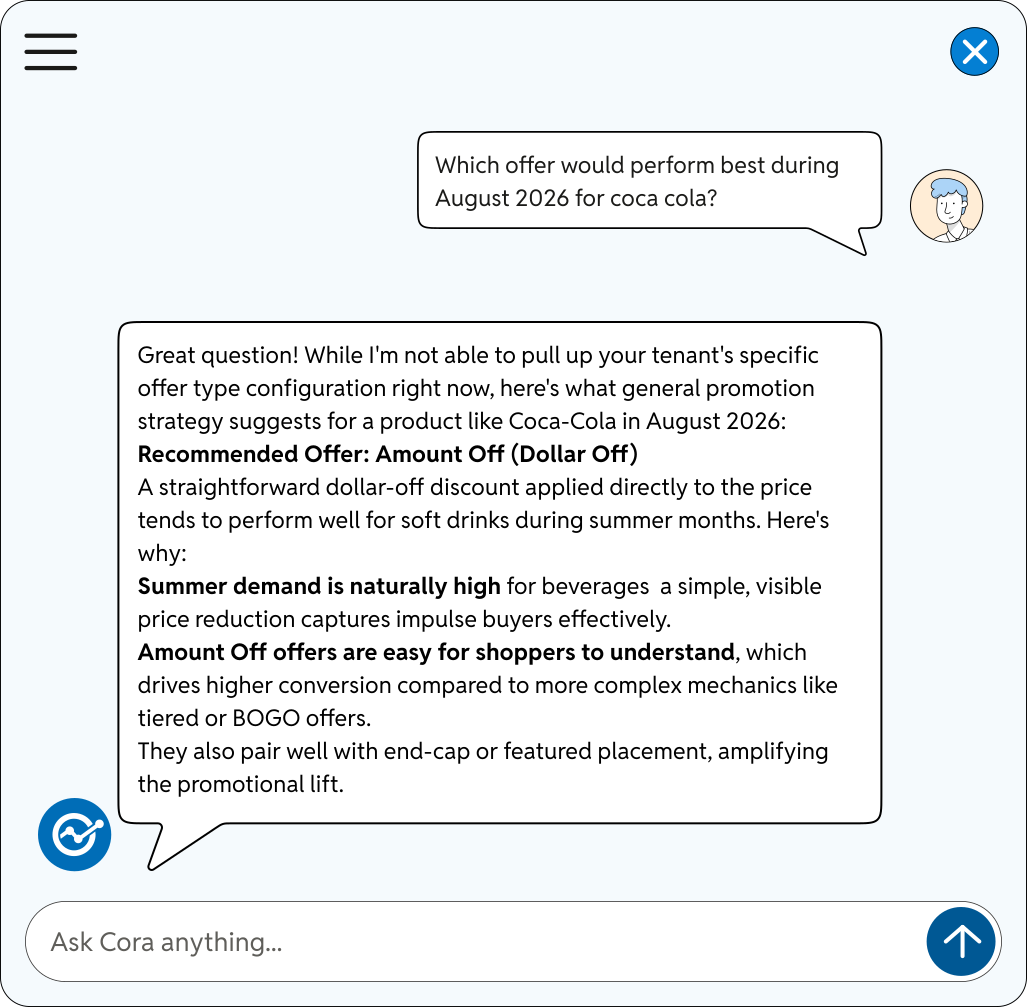
Enterprise-grade explainability: Every significant recommendation or autonomous action should be traceable. What data drove the decision? What alternatives were considered? Why was this action taken over others?
Workflow orchestration: The platform must connect to the systems your organization already uses, ERP, demand planning, WMS, promotion management, pricing tools, and coordinate actions across them without requiring manual handoffs.
Human-in-the-loop controls: Escalation logic, approval workflows, and override mechanisms must be configurable at a granular level. A system that cannot be supervised is a system that cannot be trusted.
Scalability and speed: Retail decisions happen at volume and velocity. The platform must handle operational scale without latency that undermines the value of real-time intelligence.
Data integration: Clean, connected, timely data is the foundation. Evaluate how the platform handles data from different sources, inconsistent schemas, and real-time feeds.
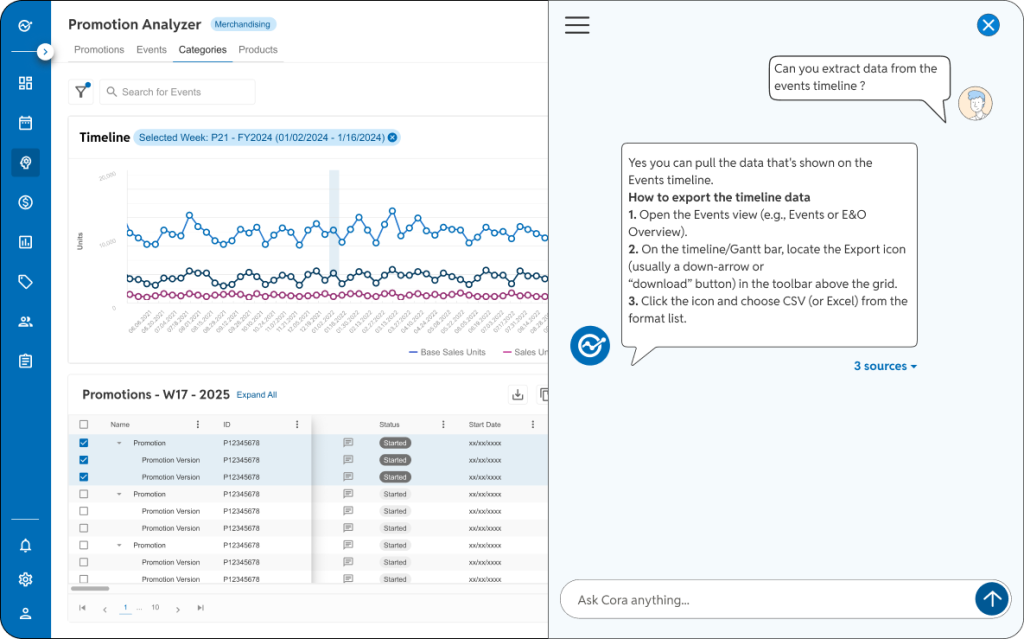
Industry-specific intelligence: Generic AI platforms require significant customization to handle industry-specific dynamics. Retail, with its promotional complexity, seasonal volatility, and omnichannel execution challenges, benefits from platforms purpose-built for the environment.
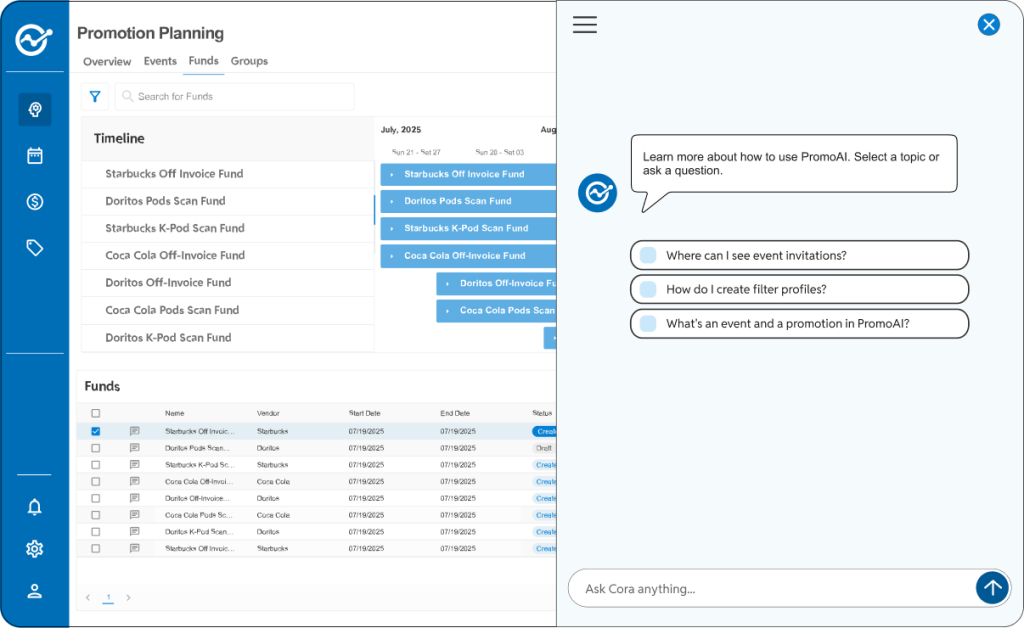
The criteria above aren’t hypothetical. They reflect what retailers consistently run into when AI implementations fall short, systems that recommend but don’t act, explain outputs in technical language planners can’t use, or operate in isolation from the workflows where decisions actually get made. Cora was built with all of it in mind. The capabilities shown here aren’t demos of what’s possible. They’re what’s living inside PromoAI today.
Where this goes next
Cora is Cognira’s first AI agent, and she won’t be the last capability we build in this direction.
The goal is clear: more of the promotion lifecycle handled intelligently, with less manual effort at every stage. That means deeper support across planning, optimization, and post-event learning, and tighter connections between Cora’s outputs and the actions that follow them.
Promotion decisions don’t live in a single system, and the retailers who benefit most from AI won’t be those with the best individual tools, they’ll be those whose tools can reason together. Cora is Cognira’s contribution to that ecosystem: a specialized agent with deep promotion expertise, built to work both within PromoAI and alongside whatever comes next.
The planners, category managers, and trade teams who use PromoAI aren’t being replaced by Cora. They’re getting leverage, the ability to do more with the expertise they already have, without the friction that’s been slowing them down.
FAQs
What is Cora?
Cora is Cognira’s AI agent built natively into PromoAI, Cognira’s enterprise promotion planning platform. She is the intelligent interface through which retail planning teams interact with PromoAI’s forecasting, optimization, analytics, vendor funding, and execution capabilities. Cora understands your promotion data and workflows,she is not a general-purpose AI assistant.
What is an AI agent in retail?
An AI agent in retail is a software system that can pursue goals, reason across data, and take actions within defined boundaries,rather than simply responding to queries. Unlike a chatbot that answers questions, an AI agent can work through multi-step planning tasks, surface conflicts, generate content, and support execution decisions. In retail, this is particularly valuable in environments like promotion planning, where decisions span multiple functions and systems simultaneously.
How does Cora work?
Cora operates through five core capabilities inside PromoAI: Understand (reading the full context of your promotion data), Guide (proactively surfacing conflicts, risks, and next steps), Create (generating briefs, reports, and documentation from live data), Explain (making PromoAI’s forecasts and optimization outputs interpretable in plain language), and Resolve (identifying and helping address conflicts in promotion plans before they become execution problems).
How is Cora different from generic LLMs or generic AI assistants?
Generic AI assistants like ChatGPT have broad general knowledge but no access to your specific promotion data, your vendor funding structures, your forecast models, or your planning workflows. Cora operates inside PromoAI, where she can see your actual promotional calendar, your live inventory positions, your historical event performance, and your current approval workflows. Her answers are grounded in your data, not general retail knowledge.
How does Cora work with PromoAI?
Cora is built directly into PromoAI; it is the intelligent interface for the platform, not a separate tool. She draws on PromoAI’s forecasting, optimization, analytics, and vendor funding modules to answer questions, generate content, and support planning decisions. When a planner asks Cora a question, she retrieves and reasons from the live data in PromoAI to produce an answer. She also helps planners navigate PromoAI’s capabilities, reducing the learning curve and broadening access across the planning team.
Can AI agents improve promotion planning?
Yes, particularly in the areas of forecast navigation, conflict detection, cross-functional coordination, and execution speed. The most significant gains come from reducing the friction between analytical outputs and planning decisions: making it faster to understand what the data means, identify what needs to change, and act on that understanding within the planning workflow.
What is a multi-agent AI system?
A multi-agent AI system is an architecture in which multiple specialized AI agents,each with expertise in a specific domain,collaborate to support decisions that cross application boundaries. In retail, this might involve a pricing agent, a supply chain agent, an assortment agent, and a promotion planning agent (like Cora) working together, through an orchestrating layer, to support a category decision that involves inputs from all four domains. Each agent contributes expertise from its domain; the orchestrator synthesizes those inputs into a unified recommendation for the human team.