
Imagine it’s a Tuesday in October. Your bestselling winter coat just sold out in every size, three weeks before peak season. Meanwhile, warehouse shelves are groaning under boxes of a slow-moving SKU nobody asked for. Sound familiar?
That gap, between what you have and what customers actually want, is a retail forecasting problem. And in today’s retail landscape, it’s an expensive one. Inventory distortion (the combined cost of overstock and out-of-stocks) is costing retailers $1.73 trillion annually. Promotions, omnichannel complexity, and compressed planning cycles have made demand planning simultaneously harder and more critical. The retailers pulling ahead aren’t the ones with better spreadsheets. They’re the ones who saw that coat flying off the shelves before it happened.
This guide breaks down how retail forecasting actually works, where traditional methods fall apart, and what separates a forecast that drives real profitability from one that just fills a planning template.
What is retail forecasting?
Retail forecasting is the process of estimating future customer demand so that purchasing, replenishment, pricing, and promotional decisions are supported by empirical data, not instinct.
It’s not the same as last year’s sales report, nor a spreadsheet you update once a quarter. Retail forecasting is a living, forward-looking process that connects what you know about the past to what you expect to happen next week, next month, or next season.
A complete retail forecasting process covers:
- Demand forecasting: How many units will customers want, by SKU, location, and time period.
- Inventory forecasting: How much stock you need to meet that demand without over-buying.
- Revenue forecasting: What top-line impact you can expect from demand changes and price moves.
- Promotional lift forecasting: How much additional demand a promotion will generate above your baseline.
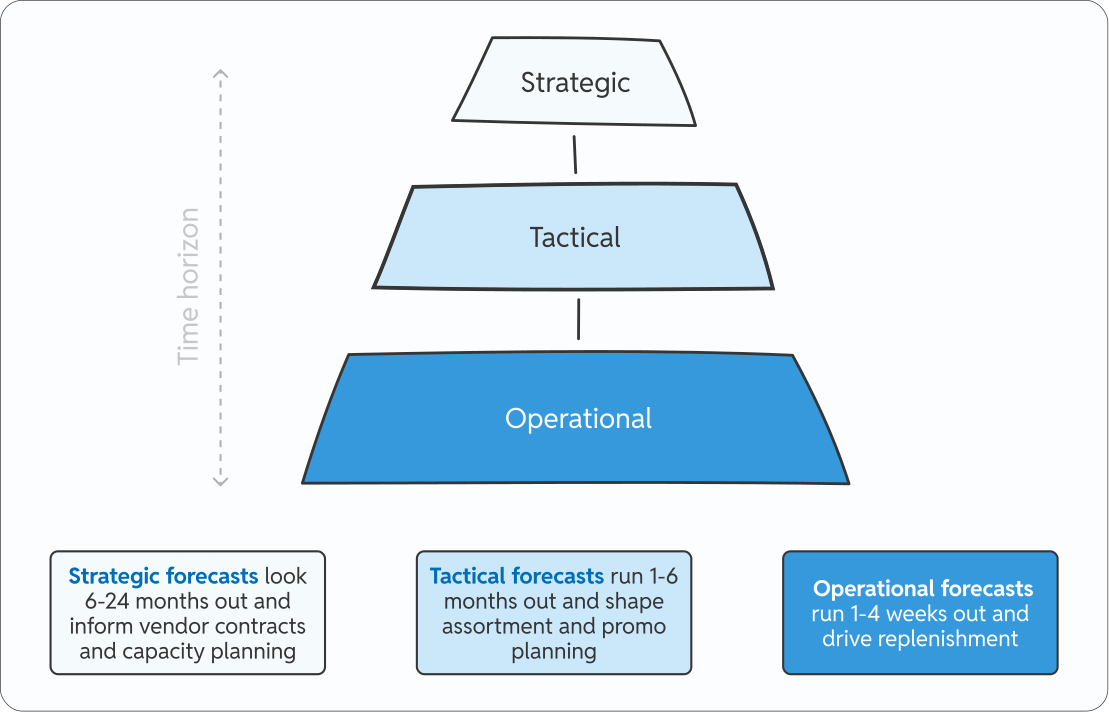
Time horizons matter too. Operational forecasts run 1-4 weeks out and drive replenishment. Tactical forecasts run 1-6 months out and shape assortment and promo planning. Strategic forecasts look 6-24 months out and inform vendor contracts and capacity planning.
What is demand forecasting in retail?
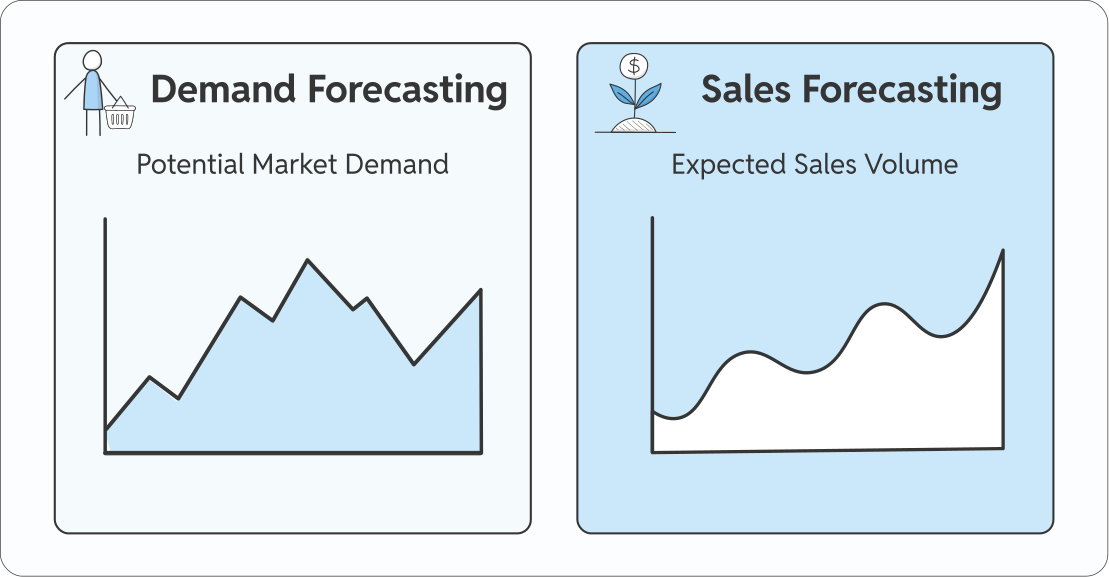
Demand forecasting is the broader practice of predicting consumer demand for a product or category. Retail forecasting applies that practice specifically to retail operations, taking into account store-level demand, promotional events, assortment dynamics, channel differences, and supply chain constraints. Retail forecasting is demand forecasting with all the operational complexity of retail baked in.
A critical distinction that trips up many planning teams: demand forecasting estimates unconstrained true demand, while sales forecasting measures only what was actually sold.
Promotional forecasting
Every promotional forecast needs to answer three questions:
- What is the true baseline demand without the promotion? Not last year’s sales, nor your average daily rate. Your clean baseline demand as it would behave if no promotions were running.
- What incremental lift will the promotion generate? Based on the promotion mechanic (percent off, BOGO, multi-buy), the channel, the SKU, and the historical response to similar events.
- How much of that lift is incremental vs. pulled-forward demand? A shopper who buys three months’ worth of cola because it’s on BOGO isn’t new volume, it’s future volume borrowed from next week’s forecast.
If you can’t answer all three cleanly, you’re not forecasting. You’re guessing with data.
Why retail forecasting matters
Before getting into methods, it’s worth grounding the discussion in outcomes. Retail forecasting isn’t a back-office analytics project, it’s a direct driver of margin, service level, and competitive position.
- Inventory cost reduction: Holding excess inventory carries hard costs, capital tied up in stock, storage and handling, and markdown exposure when the season ends. Research shows that AI-driven forecasting reduces inventory costs by 10-15% while simultaneously improving service levels, a combination that traditional approaches consistently fail to achieve.
- Stockout prevention: A stockout doesn’t just lose a sale, it sends the customer to a competitor, sometimes permanently. Out-of-stocks during promotional events are particularly damaging because you’ve already paid for the demand signal through trade spend or media. Better forecasting means better in-stock rates at the moments that matter most.
- Promotional ROI: Promotions are expensive. Trade funds, price reductions, marketing activation, none of it pays off if you over-order and take a markdown on the back end, or under-order and leave lift on the table. A precise promotional forecast determines whether a promotion actually generates incremental margin or just moves cost from one line to another.
- Labor planning efficiency: Demand forecasts also drive workforce planning. Retailers use projected traffic and transaction volume to schedule staff during peak promotional periods and avoid overstaffing during slow cycles, a direct operational benefit that falls outside the supply chain entirely.
- Competitive advantage: In a margin-compressed industry, the gap between retailers who forecast well and those who don’t shows up in EBITDA. Better forecasting supports sharper buying, cleaner assortments, and faster inventory turns, compounding advantages that are difficult to reverse-engineer from the outside.
Why retail forecasting is more complex than it looks
Most forecasting challenges fall into predictable buckets: seasonality, new product introductions, external factors like weather or economic shifts. These are real, but planners know how to handle them. Here’s what makes promotion forecasting so hard:
- Baseline contamination: Your historical sales include promoted periods. If you’re using that history to build a “normal” baseline, you’re already baking promotional lifts into your expected demand, and you’ll over-buy on non-promo weeks.
- Cannibalization: When one SKU goes on promotion, shoppers switch to it from similar items, stealing sales from those items rather than growing overall demand. If you don’t account for this shift, you’ll overestimate how much of the non-promoted items you need and end up over-ordering them.
- Halo effects: A promo on one item in a category sometimes lifts surrounding items , especially in grocery. Those non-promoted lifts are real, but if you don’t account for them, they show up as unexplained variance.
- Post-promo demand slumps: Shoppers stock up during a promo. After it ends, they buy less for a week or two. Retailers who don’t plan for this hangover get stuck with excess inventory exactly when demand has temporarily collapsed.
And that’s before you factor in competitor promotions, retail media campaigns, weather events, and channel-specific demand patterns. The honest answer is: standard forecasting models were not built to handle all of this at once.
Core retail forecasting methods
There’s no single right method. The best retail planning teams use a mix , matched to the decision at hand.
Time series analysis
Time series methods look at historical sales patterns and project them forward. ARIMA models, for instance, capture trends, seasonality, and autocorrelation.
These methods are fast, interpretable, and reliable when demand is relatively stable. But they break down under promotional events, new product launches, or major assortment changes. A spike from a BOGO deal isn’t a trend , it’s a one-time event. Feed it into a time series model without flagging it as promotional, and you’ll inflate your baseline for months.
Causal / regression forecasting
Causal models explicitly tie demand to the factors driving it , price, promotional type, display placement, competitor pricing, and more. If you know a 20% price cut on a leading SKU generates a 35% unit lift in that category, you can build that relationship into your forecast.
This is where promotion-aware forecasting starts. Causal models are essential for any retailer running more than a handful of promotions per year. The limitation is that they require well-labeled historical data , you need to know not just what sold, but what was on promotion, at what depth, in which stores, and in which format.
In our work with retailers, the most common failure point is incomplete promotion tagging in historical data. If your team has been manually adjusting forecasts after promos rather than feeding clean promotional event data into the model, you’re starting from a compromised baseline.
Machine learning and AI forecasting
ML forecasting does what statistical methods can’t: it finds non-linear relationships between hundreds of variables simultaneously. A traditional model might capture the effect of a 20% discount. An ML model captures how that 20% discount interacts with the day of week, the weather, the competing promotion running next door, and the social media impression data from a brand campaign.
For promotion forecasting specifically, ML is a game-changer. It can:
- Model cannibalization across large assortments without manually specifying every SKU relationship
- Isolate promotional lift from baseline demand with far greater precision
- Detect halo effects that human planners would never identify manually
- Predict post-promo demand dip based on pantry-loading behavior signals
Deloitte’s 2024 analysis confirms that machine learning algorithms improve forecasting accuracy by up to 30% compared to traditional methods. Retailers using promotion-aware AI forecasting typically see lower stockout rates during promoted periods and significant reductions in post-promo overstock, two of the most expensive failure modes in retail planning.
Qualitative methods
Numbers only take you so far. For new product launches, market entry decisions, or highly seasonal items with limited sales history, qualitative methods fill the gap.
- The Delphi method aggregates expert judgment iteratively, useful when you’re asking experienced buyers to estimate demand for a product with no comparables.
- Sales force composite methods draw on field teams’ knowledge of local market conditions.
- Reference product approach uses a comparable existing SKU, matched on category, price tier, brand, and format, as a demand proxy for new products until real sales history accumulates.
These approaches aren’t as scalable as statistical models, but they’re the right tool when historical data simply doesn’t exist.
Ensemble methods
The most reliable forecasts combine multiple models. An ensemble might weight a time series model for stable SKUs, a causal model during promotional windows, and an ML model for fast-moving or high-variance items.
Cognira’s approach draws from a wide variety of models and architectures, including transformer-based time series models, classic time series approaches, linear and nonlinear regression, and so on. Rather than applying a one-size-fits-all method, the right model is selected based on what works best with each client’s data, and refined through ongoing maintenance. In promotional scenarios, this flexibility is especially valuable, as the chosen model is paired with promotional lift and cannibalization adjustments to produce a single, coherent demand plan that accounts for everything happening at once, delivering a cleaner signal for buyers, planners, and supply chain teams.
The role of technology and advanced analytics
Forecasting methods are only as good as the infrastructure behind them. The gap between retailers who forecast well and those who struggle is increasingly a technology gap, not a methodology gap.
- Data integration is the foundation: A forecasting model is only as accurate as the data feeding it. For most retailers, demand signals are scattered across POS systems, ERP platforms, ecommerce backends, retail media dashboards, and supplier portals. Often in different formats, on different refresh cadences, with different definitions of the same metric. Before any advanced analytics can add value, that data needs to be unified, reconciled, and cleaned. Retailers who treat data infrastructure as a prerequisite and not an afterthought, consistently outperform those who try to layer advanced models onto fragmented inputs.
- The shift from descriptive to predictive to prescriptive: Traditional retail analytics was descriptive: what happened last week, last month, last year. Modern forecasting platforms operate prescriptively, not just predicting what demand will be, but recommending what to do about it. A prescriptive forecasting system doesn’t just tell you that demand for a promoted SKU will spike 40% next week; it tells you what replenishment order to place, which stores to prioritize, and what cannibalization exposure to expect in adjacent categories. That shift from insight to action is where technology creates a measurable business outcome rather than just a better report.
- Real-time and near-real-time forecasting: Batch forecasting, running models overnight and distributing outputs the next morning, was the standard when computers were expensive and data volumes were smaller. Modern forecasting platforms can refresh forecasts daily or intra-day for high-velocity categories, incorporating same-day POS data, live promotional performance, and real-time inventory positions. For e-commerce and omnichannel retailers where demand signals move within hours of a campaign launch, the ability to update forecasts at that cadence is no longer a competitive advantage, it’s a crucial requirement.
- Human-in-the-loop design: The best forecasting systems don’t replace planners, they make planners faster and better informed. That means flagging the items that need attention, making it easy for planners to adjust the forecast when they have local knowledge the model doesn’t, and showing clearly why the model produced a given number. When planners can’t see the reasoning behind a forecast, they don’t trust it, and they override it manually, often making things worse. Transparency isn’t a nice feature, it’s what determines whether the system actually gets used.
Retail forecasting across channels
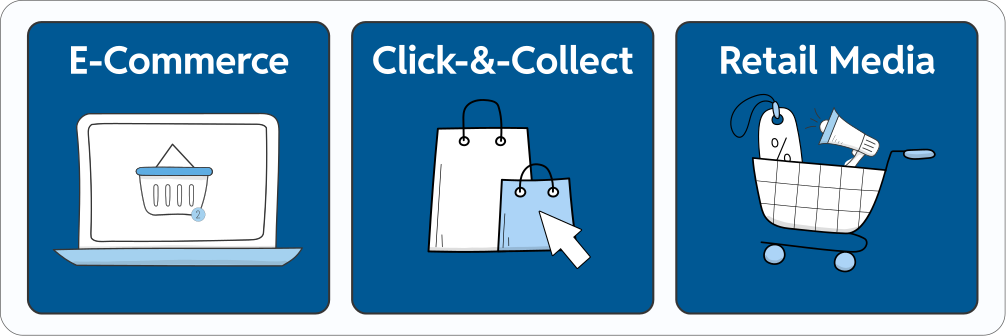
Omnichannel retail isn’t just a distribution challenge , it’s a forecasting challenge.
- E-commerce demand patterns behave differently from in-store. Online shoppers respond faster to price changes and promotions. Demand spikes can happen within hours of an email campaign drop, versus the slower build of an in-store circular. Online shopping is predicted to account for 21.8% of retail transactions in 2026 and 22.6% by 2027. That share carries demand volatility that traditional store-based models weren’t designed for.
- Click-and-collect introduces another wrinkle. A customer who orders online and picks up in-store represents inventory demand that falls on the physical location, but the demand signal originated digitally. If your forecasting system doesn’t bridge those two channels cleanly, you’ll have phantom inventory situations in-store and overstocked fulfillment nodes online.
- Retail media complicates things further. A sponsored product placement or a retailer’s onsite display ad generates a demand signal that’s close to the moment of purchase, potentially hours before the sale shows up in your system. Retailers with access to retail media performance data are starting to feed impression and click data into their demand models as a leading indicator. This is a projected $69.33 billion channel in 2026, and the forecasting implications are still being worked out across the industry.
Promotions also behave differently by channel. A BOGO deal drives higher basket sizes in-store but may drive more single-unit add-ons online. A flash sale on e-commerce can generate a demand spike over 48 hours that a store promotion would take two weeks to replicate. Forecasting these events with the same model, at the same granularity, leads to chronic misalignment between supply and channel-level demand.
Measuring retail forecast accuracy
You can’t improve what you don’t measure , but you also can’t improve if you’re measuring the wrong thing.
The core metrics:
- MAPE (Mean absolute percentage error): The average of your percentage errors across all forecasted items. It’s intuitive and widely used, but it’s distorted by low-volume items and can mask large absolute errors in high-volume SKUs.
- WAPE (Weighted absolute percentage error): The total absolute error divided by total actual demand across all items. Unlike MAPE, it weights each SKU by its volume, so high-selling products have more influence on the score. This makes it more representative of real business impact and far less sensitive to the noise introduced by slow-moving or near-zero items.
- MAD (Mean absolute deviation): Measures average absolute error in units. More useful when you care about operational impact rather than relative accuracy.
- Bias: Tells you whether your forecasts consistently run high or low. Positive bias means you’re over-forecasting. Negative bias means you’re under-forecasting. A model with great MAPE but high bias is still broken , it’s just wrong in one direction every time.
Granularity matters more than most teams realize. A MAPE calculated at the product-category-month level will always look better than the same metric calculated at SKU-store-week level. But supply chain decisions happen at SKU-store-week. If you’re reporting accuracy at a level that’s too aggregated, you’re masking the errors that actually cause stockouts and overstock.
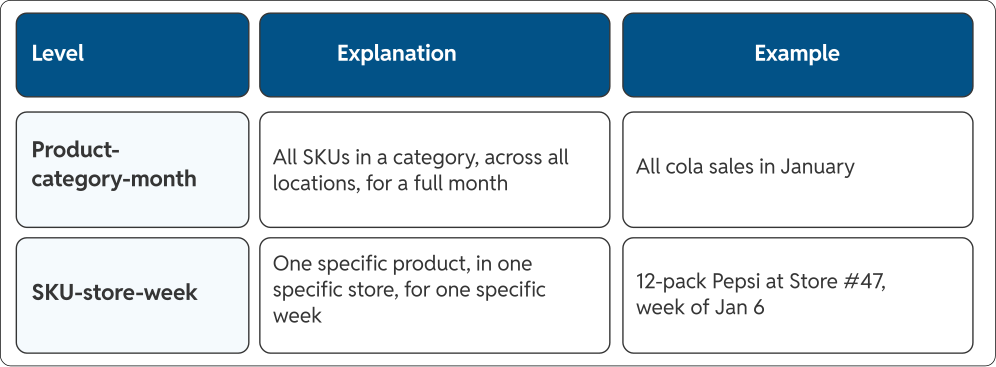
For instance, a study highlights that in grocery and FMCG, a MAPE of 10-20% at SKU-store-week is considered reasonable. In apparel or electronics, where demand is spikier, 15-25% is more typical. But these benchmarks are averages , and the real question isn’t your average MAPE, it’s your MAPE during high-stakes periods like promotions and seasonal peaks.
Here’s what most retailers don’t know: promotional periods are often excluded from MAPE calculations, either deliberately or because the events weren’t tagged properly in the system. That exclusion masks the worst forecast errors in the business, exactly the ones that cause the biggest financial damage.
How to build a retail forecasting process that actually work
- Align on what the forecast is actually for: A forecast that serves replenishment looks different from one that serves promotion planning or revenue management. Get cross-functional alignment on the primary use case before you pick a model.
- Audit your data before choosing your method:
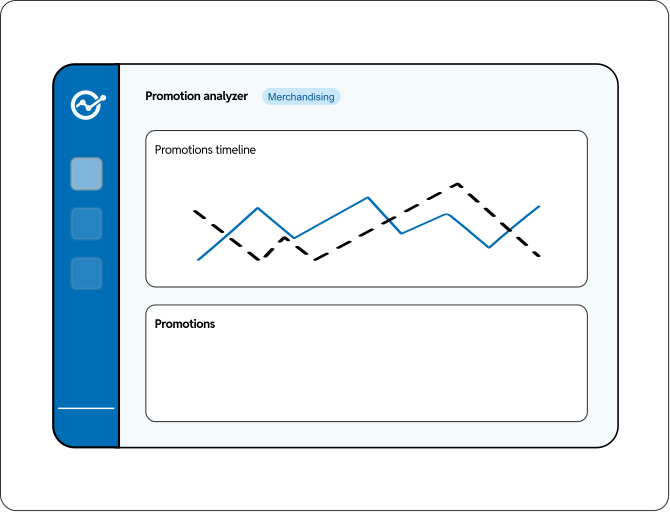
Do you have clean historical sales data with promotional events tagged? Are stockouts recorded so you can adjust for lost sales? Is your data consistent across channels?
3. Match your method to the decision: Time series for stable baseline items. Causal models for price and promotion sensitivity. ML for high-variance SKUs with complex demand drivers. Qualitative inputs for new products or market entries without a history.
4. Build the promotion calendar into the baseline, as an input, not an override:
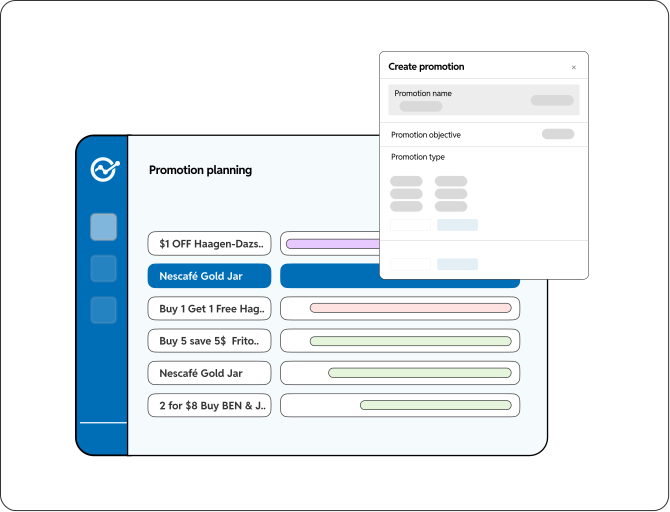
Too many retailers forecast demand without the promotion calendar, then manually adjust the output when promos are scheduled. That approach creates bias and makes accountability nearly impossible. Promotions should be a structural input to the model, not an afterthought.
5. Define ownership of inputs:
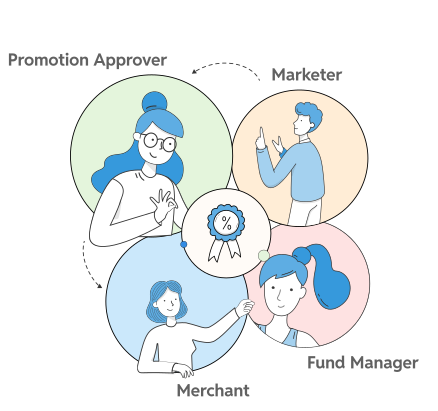
Merchandising owns the promotional calendar. Marketing owns media spend data. Finance owns revenue targets. The supply chain owns lead time and capacity constraints. Each team needs to understand what they’re responsible for feeding into the forecast and by when.
6. Set a review cadence that matches business volatility:
For a fast-moving category with weekly promotions, a monthly forecast review isn’t enough. For a slow-moving commodity category, a weekly review is overkill. Calibrate the cadence to the pace of change in your business.
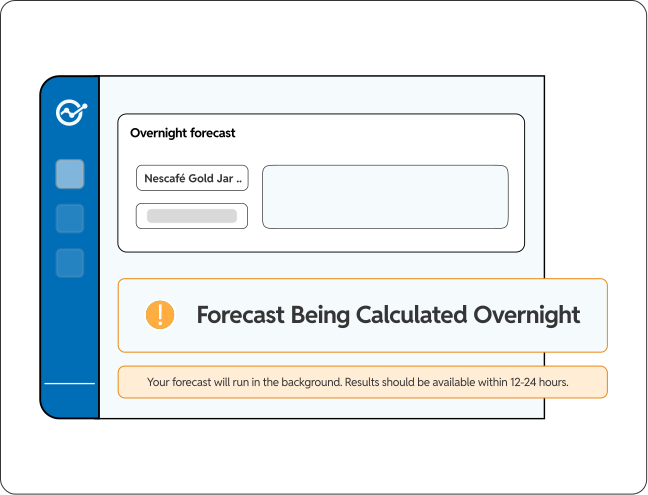
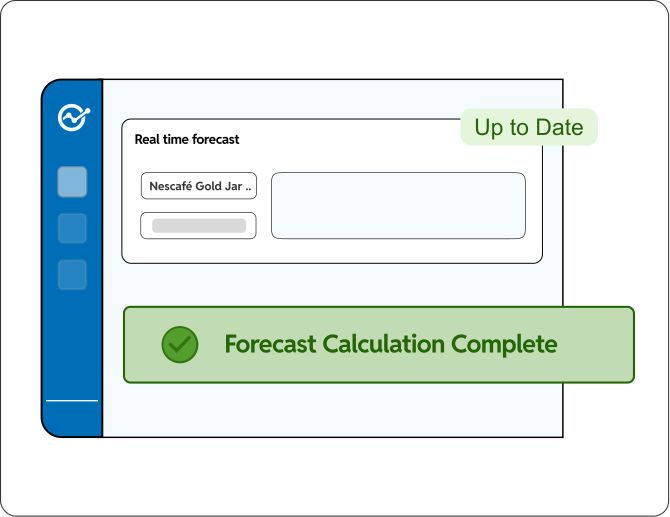
7. Measure, learn, and adjust: Forecast accuracy isn’t a fixed state , it’s a continuous improvement process. Set accuracy targets by category, track them consistently, and create a feedback loop where actual vs. forecast variance informs model refinement.
Signs your retail forecasting approach is holding you back
If more than two of these are true, your forecasting process has a structural problem:
- Promotions regularly cause stockouts during the event or overstock after it ends.
- Your team makes manual forecast adjustments after almost every campaign.
- Different departments, merchandising, supply chain, finance, are working from different demand numbers.
- Your baseline demand includes historical promotional periods, contaminating your “normal” view of the business.
- You can’t cleanly separate incremental promotional lift from pulled-forward demand.
- Post-promotion demand dips consistently catch your replenishment team off guard.
- Your forecast accuracy metrics look fine at the category level but fall apart at the SKU level.
- You have no systematic way to model or measure cannibalization across your assortment.
Retail forecasting software: What to look for
The market for retail forecasting tools ranges from bolt-on modules inside ERP systems to purpose-built AI forecasting platforms. Here’s what actually matters:
- AI/ML capability: At any meaningful scale, manual statistical models can’t keep up with the volume of SKUs, locations, and promotional events you’re managing. AI isn’t a nice-to-have , it’s a requirement.
- Transparency:
Black-box models generate distrust. Planners need to understand why the model is recommending a particular demand number, especially during promotional events. Look for explainability features that show the contribution of each driver to the forecast.
- Promotion modeling depth:
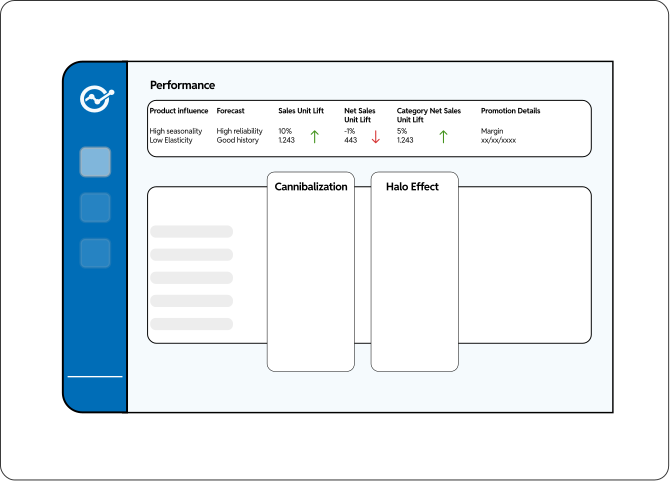
Black-box models generate distrust. Planners need to understand why the model is recommending a particular demand number, especially during promotional events. Look for explainability features that show the contribution of each driver to the forecast.
- Omnichannel data integration: Your demand data lives across POS systems, e-commerce platforms, retail media platforms, and ERP systems. The forecasting tool needs to ingest and reconcile all of it.
- Scalability and speed: Retail planning moves fast. You need a system that can refresh forecasts at meaningful frequency , daily or weekly for high-velocity categories , without requiring overnight batch runs.
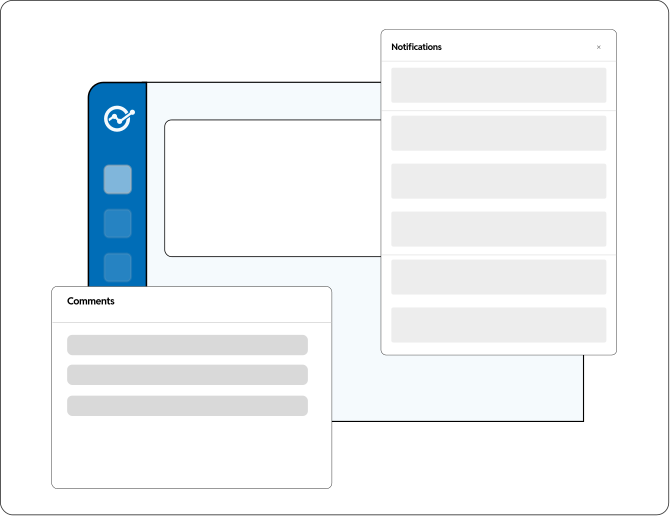
- Collaboration features:
Forecasting is a cross-functional process. Look for tools that allow merchandising, marketing, supply chain, and finance to interact with the same demand plan , with clear version control and audit trails.
Cognira is purpose-built for retailers who need promotion-aware demand forecasting at scale. Its platform, PromoAI, doesn’t just predict demand, it models the full promotional ecosystem so planners can act on cleaner signals, reduce markdown exposure, and stop fighting fires after every campaign.
PromoAI: Promotion management solution for retail
Download this guide?
FAQs
What is retail forecasting?
Retail forecasting is the process of predicting future customer demand for products, so retailers can make better decisions about inventory, pricing, promotions, and replenishment. It draws on historical sales data, market signals, and demand drivers to produce forward-looking estimates at varying time horizons , from next week’s replenishment order to next season’s assortment plan.
What is the difference between demand forecasting and retail forecasting?
Demand forecasting is the broader practice of predicting consumer demand for a product or category. Retail forecasting applies that practice specifically to retail operations , taking into account store-level demand, promotional events, assortment dynamics, channel differences, and supply chain constraints. Retail forecasting is demand forecasting with all the operational complexity of retail baked in.
How does AI improve retail forecasting accuracy?
AI improves retail forecasting by identifying non-linear relationships between hundreds of variables simultaneously , something traditional statistical models can’t do at scale. In retail, this matters most during promotional events, where the interaction between discount depth, display placement, channel, weather, and competitor activity is too complex for manual or regression-based modeling.
What role do promotions play in retail demand forecasting?
Promotions are the single largest source of forecast error in retail. They distort baseline demand, create cannibalization effects across adjacent SKUs, generate halo lifts for non-promoted items, and cause post-promotion demand dips. A forecast that doesn’t explicitly model promotional events will systematically produce inaccurate demand estimates , either over-ordering for cannibalized items or under-planning for promoted ones.
What is a good MAPE for retail forecasting?
A reasonable MAPE benchmark for high-volume, stable-demand products in grocery and FMCG is 10-20% at SKU-store-week level. For apparel and electronics, 15–25% is more typical. These ranges don’t apply to most grocery assortments though, around 80% of SKUs at a typical grocer are low-volume, where MAPE becomes unreliable. Promotional forecasts are a separate challenge entirely, with error rates often significantly higher regardless of category.
How often should retail forecasts be updated?
It depends on category velocity and business volatility. High-velocity categories with frequent promotions benefit from weekly, or even daily, forecast refreshes. Slower-moving categories with stable demand can operate on monthly cycles. The key is to match the review cadence to the pace of change in your demand environment, not to organizational convenience.