
What is category management?
Category management is the process of managing a group of related products as a strategic business unit to improve shopper value and business performance.
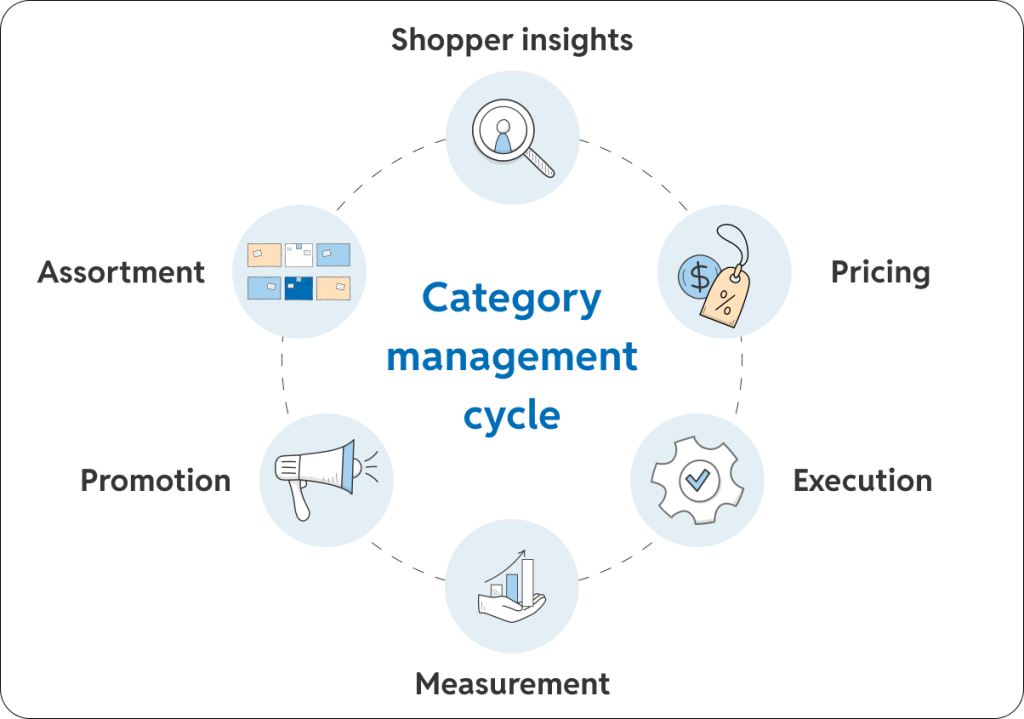
Rather than managing individual SKUs in isolation, category managers look at an entire product group; dairy, household cleaning, snacks, beverages; and make decisions about assortment, pricing, promotions, shelf placement, and supplier relationships at the category level. The goal is to serve shopper needs more effectively while delivering stronger commercial outcomes for the retailer.
In practice, category management means that a category manager is constantly asking:
- Which products belong in this category and which don’t?
- Where are we over- or under-indexed on assortment?
- How is promotional activity performing across the category?
- Which products are growing, and which are losing relevance?
- How does pricing across the category compare to the competitive set?
Effective category management has always required strong analytical judgment. What is changing is the direction of that analysis. Historically, the job was largely retrospective: explain what happened in the category and decide what to change. In 2026, the more important question is forward-looking. What is likely to happen next, and how should we prepare?
Building a category growth strategy around future demand
A strong category growth strategy doesn’t start with “How did the category perform?” It starts with “Where is the category going, and what should we do about it?”
Here’s a practical four-step framework for building category planning around future demand.
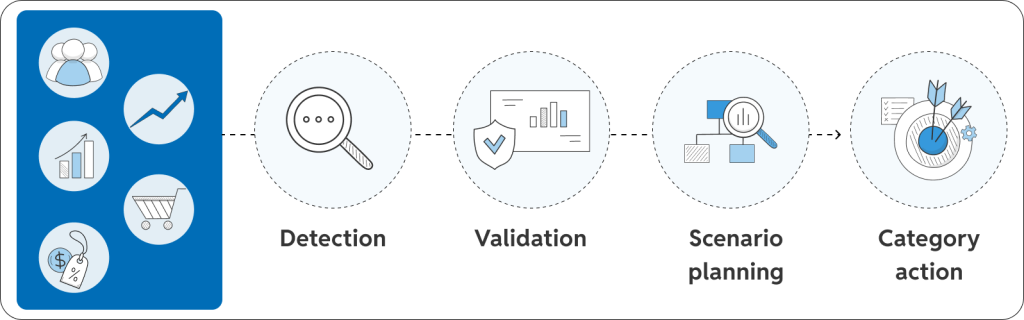
1. Identify the signals that matter
Not every data point is a useful signal. Category managers should focus on signals that are most likely to reflect genuine changes in shopper demand: sustained product-level growth, promotional lift patterns, regional demand variation, new product adoption rates, and competitive price changes.
Historical sales are the foundation, but they’re a lagging indicator. Signals like promotional response and regional demand shifts can reveal where the category is moving before it shows up clearly in aggregate numbers.
2. Separate trends from noise
A sales spike is not automatically a trend. Before building a category response around a demand increase, category managers should ask:
- Has the increase held across multiple weeks?
- Is it visible across stores and regions, or concentrated in a small cluster?
- Could it be explained by a promotion, a competitor out-of-stock, or a one-time event?
- Is a similar pattern visible in adjacent products or formats?
The goal is to distinguish a meaningful demand shift from a temporary anomaly. Acting too quickly on noise can be as costly as missing a real trend.
3. Translate trends into category decisions
Insights are only useful if they lead to action. When a trend is validated, the question becomes: what does this mean for the category plan?
A demand signal can inform decisions across the full category toolkit:
- Assortment: Add, expand, or reduce products based on demand direction
- Pricing: Adjust price points in response to competitive shifts or changing demand elasticity
- Promotion: Prioritize promotional investment on products with growing momentum
- Inventory: Adjust forward buys based on expected demand trajectory
- Space: Reallocate shelf space toward products gaining traction
- Supplier collaboration: Engage suppliers earlier when demand acceleration is expected
4. Build scenarios before committing
Rather than planning for a single expected outcome, category managers should consider a range of possibilities before executing. What happens if demand continues at the current rate? What happens if the trend slows? How should you respond to a competitor’s price change? And what if a promoted product outperforms its forecast?
Scenario thinking doesn’t require complex modeling. It requires the habit of asking “what if?” before locking in a category plan, and having a response ready for each plausible outcome.
How retail demand planning supports better category management decisions
Retail demand planning is often treated as a supply-chain function: forecast the volume, plan the inventory, manage the flow. But for category managers, demand planning is also a commercial tool.
When demand planning is connected to category strategy, not just to replenishment, it can support much earlier decisions:
- Which products are likely to see accelerating demand over the next planning cycle?
- Where might seasonal demand arrive earlier or later than historical averages suggest?
- Which product clusters could benefit from increased promotional support based on current momentum?
- Where might assortment changes create volume risk or upside?
Consider a category manager seeing a rising demand signal in a product cluster. Rather than simply increasing the inventory order, connecting that signal to a demand planning view allows the team to evaluate whether the increase looks seasonal, promotion-driven, geographically concentrated, or part of a broader category shift. Each answer points to a different response.
The value of retail demand planning for category managers is not in the forecast itself. It’s in what the forecast makes possible: faster, better-grounded category decisions made earlier in the planning cycle.
The category manager’s playbook
When a category signal appears, most teams face a common challenge: knowing what to do with it. This table maps signal types to likely meanings and practical next steps.
|
Signal |
Meaning |
Category manager action |
|
Sustained sales growth |
Emerging demand shift |
Review assortment and inventory position |
|
Short-term sales spike |
Temporary event or promotion |
Validate before scaling response |
|
Declining product demand |
Product losing category relevance |
Evaluate assortment role |
|
Strong regional variation |
Localized trend |
Consider regional strategy |
|
Higher-than-expected promotional response |
Greater price or promotion sensitivity |
Reassess promotional investment |
|
Demand shifting between products |
Substitution or preference change |
Review category mix |
|
New product outperforming similar launches |
Format or positioning resonating |
Prioritize ranging and support |
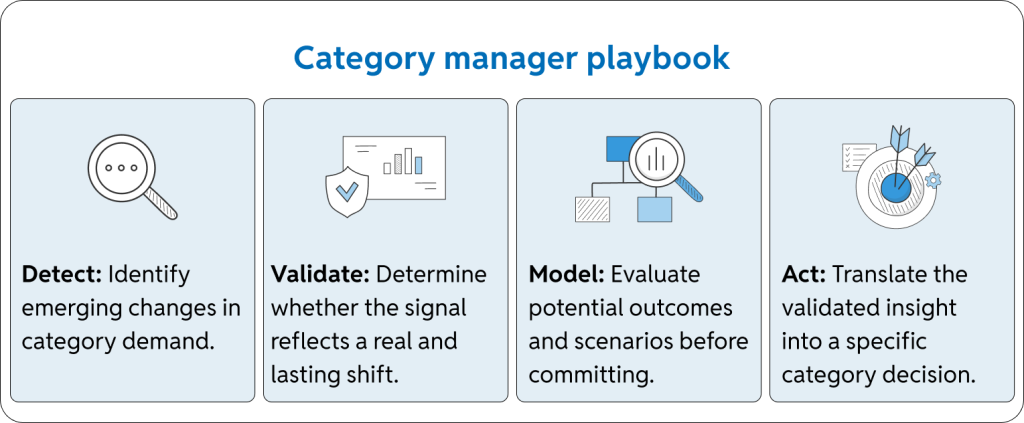
Category managers who work through these signals systematically move through four stages:
Common category management mistakes to avoid
Managing from the rearview mirror
|
Problem: Relying entirely on historical sales data to plan future category activity. |
Fix: Combine historical results with current demand signals and forward-looking scenario analysis. |
Treating every trend as a growth opportunity
|
Problem: Responding to every sales increase as if it represents a lasting category shift. |
Fix: Validate signals against seasonality, promotion effects, regional variation, and competitor activity before committing. |
Separating forecasting from category strategy
|
Problem: Demand forecasts are produced in one team and rarely connected to commercial category decisions. |
Fix: Build demand planning directly into assortment, promotion, pricing, and inventory planning conversations. |
Focusing on forecast accuracy alone
|
Problem: Measuring success by how close the forecast was to actual results, rather than by whether it improved decisions. |
Fix: Evaluate whether demand insights led to better category outcomes; stronger growth, fewer out-of-stocks, reduced overstock, better promotional return. |
FAQs
What is category management?
Category management is the practice of managing a group of related products as a strategic business unit. Retailers and category managers use it to make coordinated decisions across assortment, pricing, promotions, and shelf placement at the category level, rather than managing individual products in isolation, with the goal of improving shopper value and business performance.
What does a category manager do?
A category manager is responsible for the performance of a defined group of products. Day-to-day responsibilities include reviewing category sales, making assortment recommendations, planning and evaluating promotions, monitoring competitive pricing, collaborating with suppliers, and identifying where the category has growth potential. Increasingly, the role also involves identifying demand trends and planning for future category performance.
What is a category growth strategy?
A category growth strategy is a plan for building sales and margin within a product category over time. It connects category performance analysis with shopper demand signals, assortment decisions, pricing, promotional activity, and emerging trends. A strong category growth strategy doesn’t only explain current performance, it identifies where the category is headed and what actions could capture the opportunity or manage the risk.
What is retail demand planning?
Retail demand planning is the process of using historical sales data, demand signals, and forecasting methods to estimate future demand and support inventory and commercial decisions. For category managers, demand planning helps anticipate how category demand may shift across seasons, promotions, and market changes, enabling better decisions on assortment, replenishment, and promotional investment.