Introduction
Picture this: it’s mid-February and you’re staring at three hundred units of a holiday sweater that never moved. Your warehouse team wants the shelf space back. Your CFO wants to know about margin targets. And somewhere in your gut, you know that slapping a “70% OFF” sticker on everything is going to feel like a fire sale, because it basically is one.
A disciplined markdown strategy is what separates retailers who recover cleanly from those who bleed out, and it has to be built before the crisis, not during it.
What is a markdown strategy?
A markdown strategy is a planned, systematic approach to reducing retail prices to stimulate demand, clear excess inventory, and manage product lifecycles.
This isn’t the same as putting items on sale when you feel like it. Compare the two:
| Without a markdown strategy | With a markdown strategy |
| Price cuts happen in a panic | Triggers are defined in advance |
| Margins erode unpredictably | A margin floor is set and defended |
| Deep cuts arrive too late | Staged discounts start early, go deeper as needed |
| Customers learn to wait for sales | Urgency is built into the cadence |
The difference compounds over time. Retailers with a disciplined markdown strategy spend less on clearance, recover more capital per unit, and carry less dead stock into the next season.
Why most markdown strategies fail
Before getting to the framework of a markdown strategy, it helps to name the failure patterns, because at least a few of these will be familiar.
Waiting too long: The instinct to hold out for full-price buyers is understandable and costly. A product that clears at 25% off in week 8 needs 50% off in week 12. Early, shallow markdowns almost always outperform late, deep ones.
Confusing markdowns with promotions: A promotion is temporary, the price returns to normal when the event ends. A markdown is a permanent (or semi-permanent) price change tied to the product lifecycle. Different intent, different duration, different strategic impact.
No margin floor: Deloitte puts the average net profit margin for the top 250 retail companies at just 3.1%-3.7%. Marking down without knowing your break-even price, factoring in cost of goods, holding, and fulfillment, is how you accidentally sell at a loss.
Blanket discounts instead of SKU-level targeting: A site-wide 30% sale moves some inventory but also destroys margin on products that would have sold anyway. Effective markdown strategies are surgical, not sweeping.
The 5 pillars of a solid markdown strategy
1. Define your triggers before the season starts
Decide in advance what conditions initiate a markdown. The three most common trigger types:
- Time-based: “Apply 20% off after 30 days on shelf; 40% after 60 days.”
- Sell-through rate: “Begin markdowns when sell-through falls below 40% at week 8 of the selling season.”
- Inventory aging: Flagged automatically by your POS or inventory system.
Pre-defining triggers removes the emotional decision-making that causes retailers to hold too long. Build your markdown calendar at the same time you build your buy plan.
2. Use a tiered discount structure
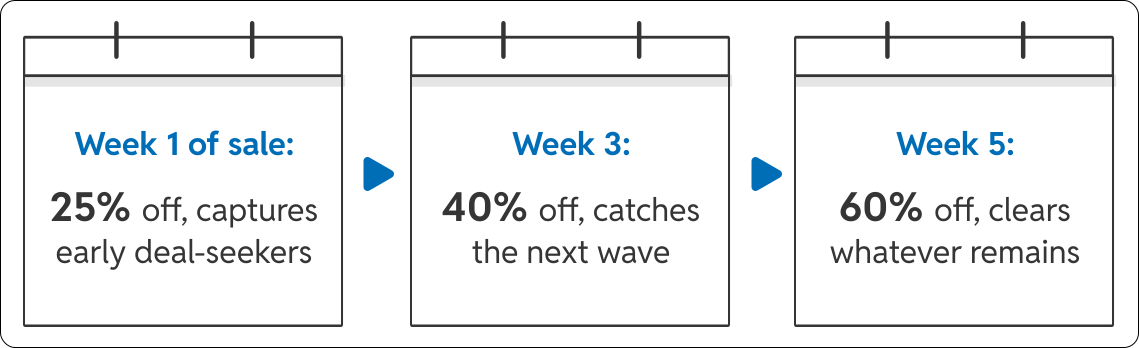
A single dramatic markdown signals desperation and trains customers to wait. Tiered markdowns work differently: start shallow to capture deal-seekers who still act quickly, then deepen the cut for the stubborn stock.
A simple structure for apparel:
- Week 1 of sale: 25% off, captures early deal-seekers
- Week 3: 40% off, catches the next wave
- Week 5: 60% off, clears whatever remains
3. Set and defend a margin floor
Before any markdown strategy goes live, know the minimum price at which you still break even:
4. Segment by SKU, channel, and location
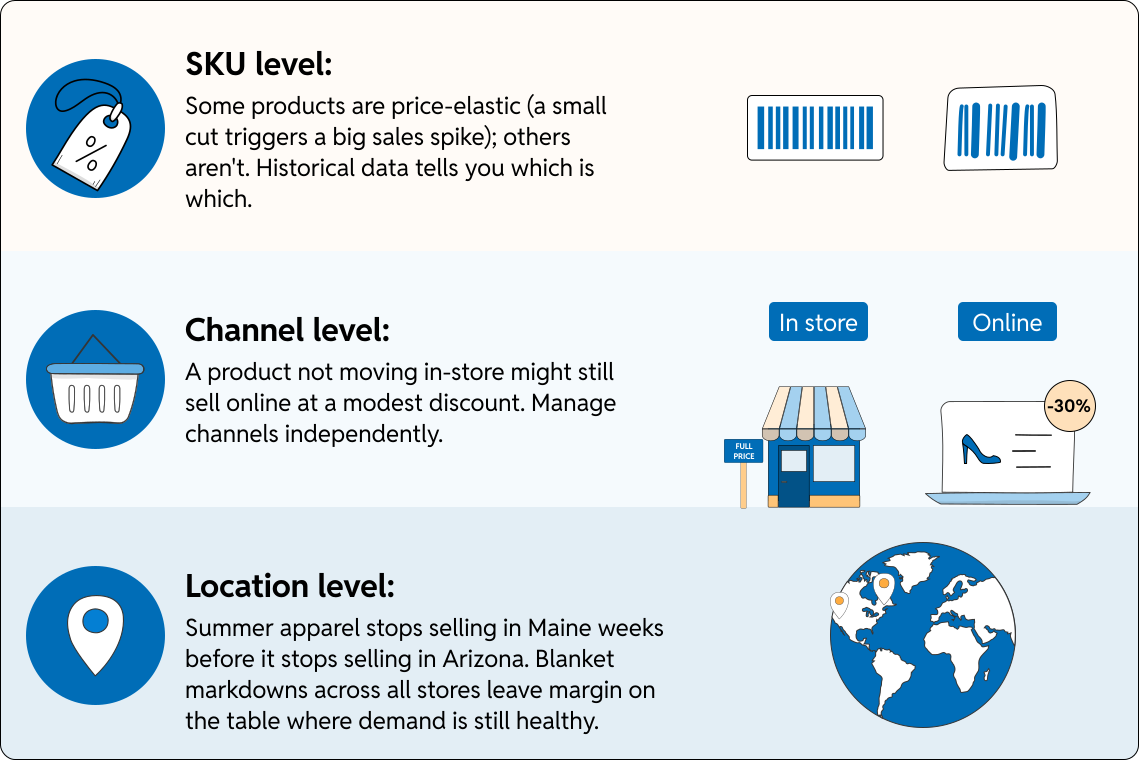
Not all inventory responds to markdowns the same way.
- SKU level: Some products are price-elastic (a small cut triggers a big sales spike); others aren’t. Historical data tells you which is which.
- Channel level: A product not moving in-store might still sell online at a modest discount. Manage channels independently.
- Location level: Summer apparel stops selling in Maine weeks before it stops selling in Arizona. Blanket markdowns across all stores leave margin on the table where demand is still healthy.
5. Measure, learn, and feed the next season
A markdown strategy only improves if you close the loop. Track these KPIs after every event:
- Sell-through rate post-markdown
- Gross margin recovery
- Average markdown depth (% discount taken)
- Days-to-clear
- Revenue recovery rate
If a category consistently requires 40% markdowns, you’re either overbuying or mispricing at launch. The markdown data is the diagnosis.
Markdown strategy by retail category
Fashion and apparel: Start your markdown calendar before the season ends, not after. A staged approach beginning at week 10 of a 14-week season gives you two full markdown tiers before clearance. Build your markdown budget into the initial buy plan. Key pitfall: fashion is highly trend-sensitive, so unsold seasonal inventory loses perceived value fast, early, shallow discounts protect brand positioning far better than end-of-season fire sales.
Electronics and tech: When a new model launches, the previous generation needs to move fast, consumers know it’s old. Pair markdowns with bundled accessories to increase average order value on discounted units. Typical markdown trigger: initiate within 30-60 days of a successor model’s release, not at the end of a calendar period. Holding too long collapses the price floor as third-party resellers undercut you.
Grocery and perishables: Markdowns here are triggered by expiry proximity, not sell-through. Automate price changes tied to days-to-expiry windows, for example, 20% off at 5 days remaining, 40% off at 2 days. The cost of not marking down (waste and write-offs) typically exceeds the discount. Unlike fashion or electronics, there is no brand equity risk to aggressive markdowns here; the cost of inaction is entirely operational.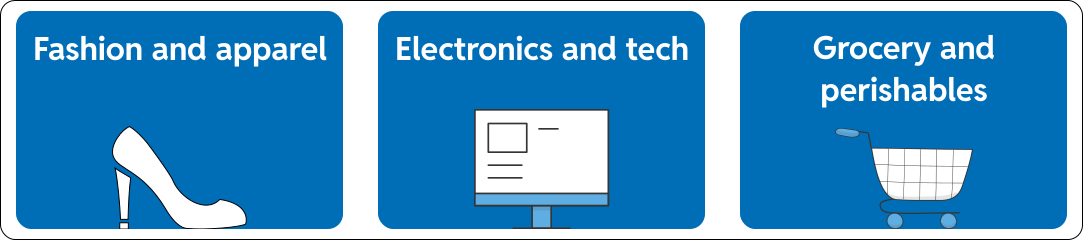
Common mistakes to avoid for an optimal markdown strategy
Training customers to wait: Frequent, predictable markdowns create a base that never pays full price. Vary your timing and use loyalty-program early access rather than public discounts to reward your best customers.
Skipping the post-season review: Markdowns that don’t generate learnings are just losses. A half-day post-season analysis saves multiples of that in next year’s clearance costs.
Marking down everything equally: Different SKUs have different elasticity and cost structures. Apply SKU-level decisions, not category-wide ones.
Conclusion
The retailers who have strong markdown strategies aren’t the ones who never have unsold inventory. They’re the ones who planned for it: triggers built into the buy plan, tiered discounts ready before the season started, a margin floor defended under pressure, and data feeding the next cycle.
Markdowns will happen. The question is whether they happen on your terms or the inventory’s. Build your markdown strategy now, before you’re staring at a warehouse of February sweaters wondering where the season went.