Imagine raising the price of one of your best-selling products by 5%. On a premium private-label olive oil, customers barely notice. While on a nationally branded pasta sauce sitting next to three cheaper alternatives, where price sensitivity is much higher, that same 5% triggers a noticeable drop in volume. Customers switch, and some don’t come back. Same price move but very different outcomes.
That’s price sensitivity in action. Understanding it is one of the most valuable skills a retail pricing team can develop. With it, your team can identify where you have room to move, and where you don’t, before you make a change that costs you volume, revenue, or customer trust.
What is price sensitivity?
Price sensitivity measures how strongly customers respond to price changes. When a small price increase causes a large drop in sales, a product is highly price sensitive. When demand holds steady despite a price change, that product is relatively price insensitive.
In economics, this relationship is captured by price elasticity of demand:
Price elasticity = % Change in quantity demanded ÷ % Change in price
- An elasticity of -2 means a 1% price increase is associated with a 2% drop in volume.
- An elasticity of -0.3 means a 1% price increase leads to only a 0.3% drop in volume.
Price sensitivity and price elasticity tell you the same story from different angles. Elasticity quantifies it, while Price sensitivity helps you decide what to do about it.
What makes a product price sensitive?
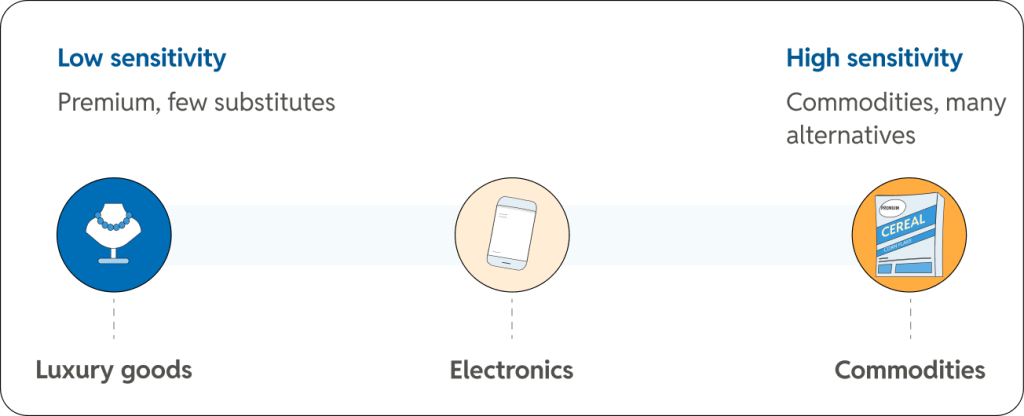
Not all products respond to price changes the same way, and within a category, price sensitivity can vary by brand, pack size, channel, and customer. Here are the four factors that matter most:
Availability of substitutes
When shoppers can easily swap one product for another, a price increase gives them a reason to do it. Commodity-style products, basic pantry staples, generic household cleaners, and store-brand equivalents, often face higher price sensitivity because the decision to switch costs the customer almost nothing.
Purchase frequency
Frequently purchased products carry more weight in shoppers’ mental price models. A customer may not remember exactly what they paid for a phone case three years ago, but they have a clear sense of what pasta costs. Everyday essentials are often closely watched, which makes price changes more visible, and more likely to drive a response.
Product differentiation
Strong brands, unique formulations, and distinctive products tend to have more pricing flexibility. Customers assign value beyond the commodity price. A branded product with a loyal following can absorb a moderate price increase without losing significant volume, while a comparable private-label item in the same aisle may not have that room.
Competitive price visibility
When customers can compare prices in seconds, across stores, apps, and online retailers, the bar for competitive pricing gets higher. Products that appear on price comparison platforms or are frequently featured in competitor promotions face greater price sensitivity than those that live outside that spotlight.
How to conduct a price sensitivity analysis
Here’s a practical four-step framework using the data your team already has:
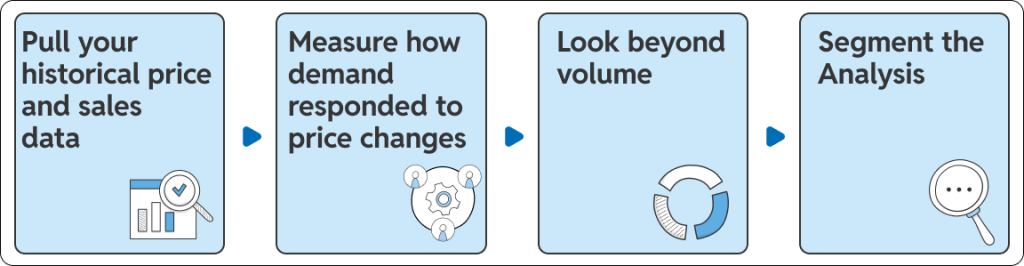
Step 1: Pull your historical price and sales data
Start with what has already happened. For each product you’re analyzing, gather:
- Unit sales over time
- Price at each point in time
- Promotions and promotional prices
- Revenue and margin
- Competitor prices where available
Historical data can reveal how demand responded to previous price changes, both when you changed prices and when competitors did.
Step 2: Measure how demand responded to price changes
Look at periods where prices changed, your own price moves or competitor shifts, and compare unit sales before and after. Use the elasticity formula to estimate demand response:
Elasticity = % Change in volume ÷ % Change in price
|
Be careful: Real-world data is never perfectly clean. Account for promotions, seasonal patterns, and any external factors that may have influenced sales during the period you’re measuring. |
Step 3: Look beyond volume
Volume is not the whole story. A product that sells 3% fewer units after a 5% price increase may still generate more revenue than it did before. It may also deliver better margin if cost structures are held steady.
For every price sensitivity analysis your team runs, calculate:
|
Metric |
Before price change |
After price change |
|
Units sold |
– |
– |
|
Revenue |
– |
– |
|
Margin per unit |
– |
– |
|
Total margin |
– |
– |
Also consider category-level effects: did the customer switch to another product in your range, or did they leave entirely? Customer switching behavior matters as much as product-level volume.
Step 4: Segment the Analysis
Price sensitivity is not uniform across customers, stores, or channels. A product may be more price sensitive in a price-competitive urban market than in a rural area with fewer alternatives. Compared to in-store shoppers, digital consumers tend to conduct price comparisons far more frequently.
Where you have the data, segment your analysis by store cluster, geography, customer type, or channel. Consequently, the insights are more precise, and so are the pricing decisions that follow.
How to price without losing customers
Protect your most visible products
Some products are closely watched by customers and competitors alike. These are usually high-frequency purchases with well-known price points. Use your price sensitivity analysis to identify them and monitor them closely. Naturally, these are not the products to test aggressive price increases on.
Differentiate pricing by product role
Products serve distinct roles: traffic drivers require competitive pricing to shape value perception, while margin builders, premium items, and private labels have unique elasticity profiles to absorb varying price changes. Align pricing with each product’s specific role rather than applying uniform category rules.
Test before you scale
If you’re considering a meaningful price change, test it in a limited set of stores before rolling it out widely. A controlled pilot gives you real demand data with limited downside risk.
Monitor after every change
Price sensitivity is not fixed. In fact, it shifts with competition, inflation, seasonal demand, and consumer confidence. Track what happens after every price change—volume, revenue, margin, and customer behavior—and treat that data as an input for the next decision.
FAQs
What is price sensitivity analysis?
Price sensitivity analysis is the process of measuring how changes in price affect customer demand for a product. In retail, it involves examining historical sales data, price changes, and competitor pricing to understand which products have elastic demand (highly responsive to price) and which are inelastic, and using those findings to make more informed pricing decisions.
What are price-sensitive products?
Price-sensitive products are products where even small price changes cause a noticeable shift in customer demand. This is typically common with frequently purchased items, products that have many direct substitutes, or items where customers can easily compare prices across retailers. Examples include branded commodity staples and everyday essentials where shoppers maintain a strong mental price reference.
How do you measure pricing sensitivity?
The starting point is historical transaction data. Compare unit sales before and after price changes, calculate price elasticity (% change in volume ÷ % change in price), and look at revenue and margin alongside volume. For new products without a price history, structured pricing tests or competitive benchmarking can provide a baseline.
What is the difference between price sensitivity and price elasticity?
Price sensitivity is the broader concept, it describes how much customers react to price changes in terms of purchasing behavior. Price elasticity of demand is the specific formula used to quantify that relationship (% change in quantity ÷ % change in price). Elasticity gives you a number; sensitivity gives you a framework for acting on it.