We are living through one of the most significant shifts in modern software development. AI is no longer a future concept or a niche experiment, it is actively reshaping how engineering teams think, build, and deliver. The narrative often defaults to replacement: AI will write all the code, AI will make engineers redundant, expertise will become obsolete. At Cognira, we see it very differently.
The real story is about amplification, and what it takes for engineering organizations to harness that potential responsibly, without sacrificing the discipline that makes great software possible in the first place.
AI as a force multiplier, not a replacement
The software industry is rapidly evolving toward more agentic workflows: AI systems capable of assisting with coding, automation, complex reasoning, and orchestration at scale. Tools like Anthropic’s Claude Code are already being integrated into development lifecycles at forward-thinking organizations around the world.
At Cognira, we are not watching this shift from the sidelines. We are actively exploring these capabilities, and investing in our own AI through Cora, our homegrown AI agent inside PromoAI. Cora continues to expand in sophistication, growing from basic product navigation assistance to deep contextual understanding of retail concepts, system architecture, and dynamic discovery workflows.
But the key distinction remains consistent:
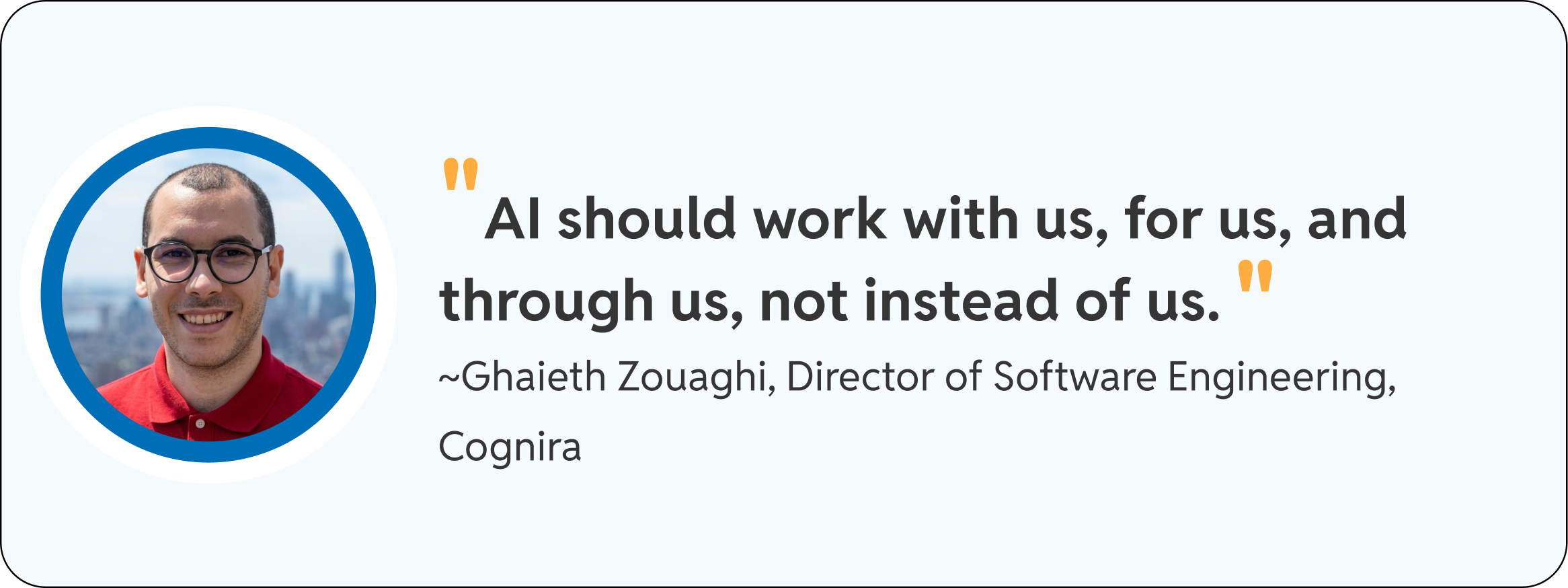
This is not just a value statement. It is a practical operating principle that shapes how we evaluate tools, structure teams, and make architectural decisions. The best engineering organizations of the future will not necessarily be the ones with the largest headcount. They will be the ones that know how to combine strong engineering fundamentals with AI leverage, in a disciplined, scalable, and accountable way.
Not every engineering task is “10x-able”
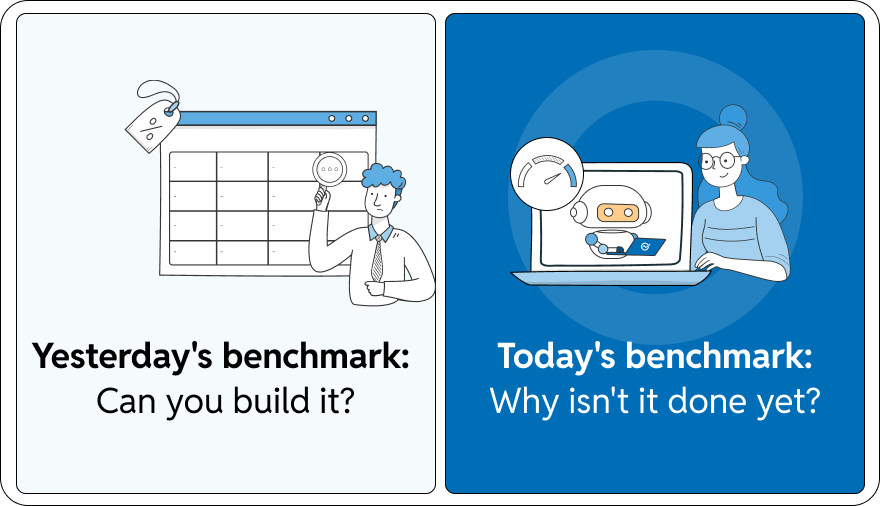
One of the most grounding realizations of the AI era is deceptively simple: some engineering tasks benefit enormously from AI acceleration. Others do not. Some categories of work can genuinely become 10x faster with AI assistance. Others have hard limits tied to complexity, domain knowledge, or the irreducibly human nature of judgment and tradeoff navigation. Pretending otherwise leads to inflated expectations, poor planning, and ultimately disillusionment with AI tooling.
That leads to what may be one of the most strategically important questions facing software leaders today:
How do we structure engineering work so that more of it becomes reliably AI-acceleratable?
When AI amplification works best
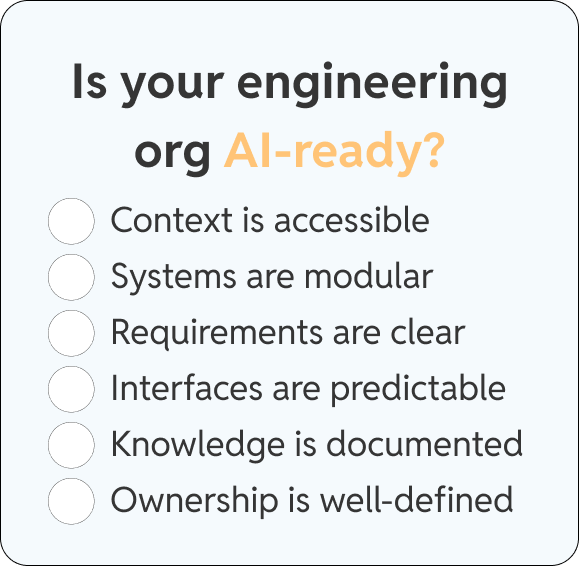
AI performs at its highest effectiveness when:
- Context is accessible: the AI can reason about the full picture of a system or requirement
- Systems are modular: work can be cleanly scoped and decomposed
- Requirements are clear: the output has something concrete and specific to target
- Interfaces are predictable: fewer unexpected interactions between components
- Knowledge is documented: institutional and tribal knowledge has been externalized
- Ownership is well-defined: clear accountability drives cleaner, more intentional systems
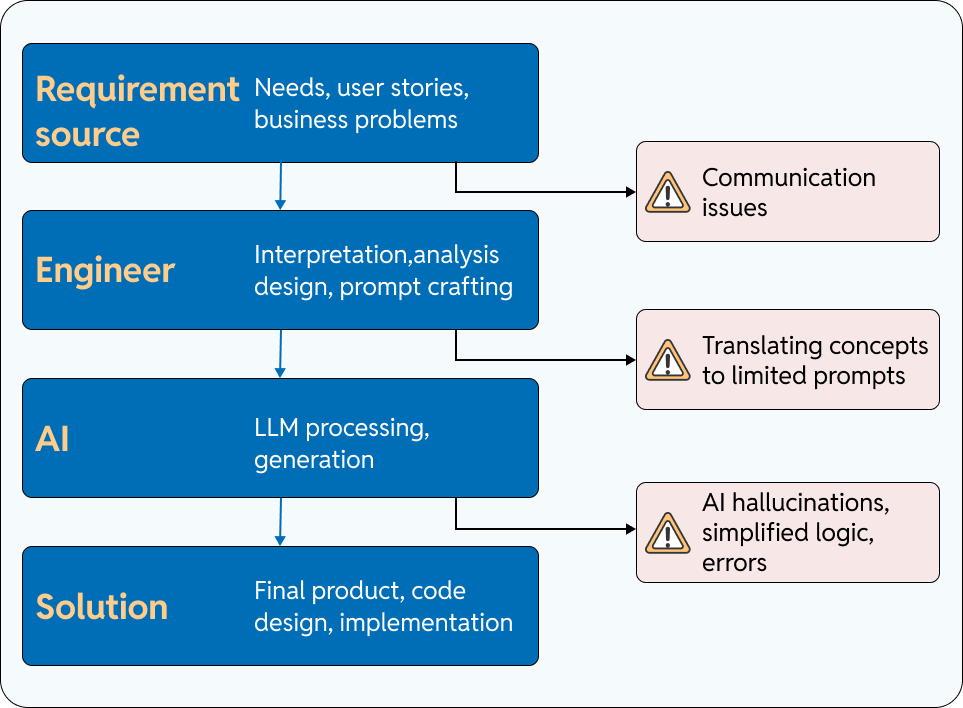
The ideal engineering flow: Minimize the distance from the source
There is a principle that becomes even more powerful in the AI era: the signal is always strongest when closer to the source.
In the most effective engineering setup, a highly capable engineer:
- Hears a requirement directly from a client or stakeholder
- Understands the full business context immediately and holistically
- Uses AI to accelerate and sharpen implementation
- Delivers a working solution rapidly and with full confidence
Every additional handoff between the person defining the requirement and the person implementing it introduces information loss, context dilution, longer feedback loops, and coordination overhead, all of which reduce the quality and speed of AI-assisted output.
An engineer who hears a customer problem firsthand gains dramatically richer context than someone reading a ticket several days removed from the original conversation.
And in the AI era, richer context is directly correlated with better prompting, better reasoning, and ultimately better output. The investment in reducing distance from the source is an investment in AI effectiveness, not just team structure.
AI is expanding what engineers can do
Beyond productivity, there is another major structural shift underway: the gradual erosion of rigid technical specialization as the only path to engineering contribution.
Traditionally, engineering organizations relied heavily on narrowly defined roles; backend engineers, frontend engineers, data engineers, ML engineers, infrastructure engineers. Those distinctions still matter, especially at scale and for deep system ownership. But AI is increasingly enabling individual engineers to operate effectively outside their primary domain.
A backend engineer today may confidently:
- Build and iterate on a frontend workflow
- Modify infrastructure or deployment configuration
- Navigate and contribute to an unfamiliar codebase
- Prototype a UI interaction or data visualization
Not because they have suddenly mastered every domain overnight, but because modern AI tools dramatically lower the cost of exploration and discovery. They explain unfamiliar code patterns, surface architectural intent, generate working scaffolding, accelerate onboarding into new systems, and reduce the friction of context-switching between technical domains.
The non-negotiable rule: Understand what you ship
All of this potential comes with one principle that we consider non-negotiable at Cognira:
Never use AI output unless you fully understand what it is doing.
This is how engineering organizations avoid accumulating technical debt disguised as productivity. There is a dangerous pattern emerging across the industry, teams accepting generated output at face value, shipping code they cannot reason about, and building systems they could not explain under scrutiny. The short-term velocity gains are real, and the long-term consequences are severe.
How AI will change engineering organizations over the long term
The long-term organizational impact of AI in software engineering extends well beyond productivity tooling. Over the coming years, we expect to see:
- Smaller, highly capable engineering teams with broader, more distributed ownership
- Faster implementation and iteration cycles as the baseline expectation
- More product-oriented engineers working closer to the problems they are solving
- Reduced coordination overhead and fewer handoff-driven bottlenecks
- Stronger emphasis on architectural clarity as a prerequisite for AI effectiveness
- Higher baseline expectations for execution velocity at every level of the organization
But none of this removes the need for engineering rigor. In fact, strong engineering principles become more important in the AI era, because poorly structured systems become exponentially harder to manage when accelerated by automation.
Conclusion
The industry is moving faster because of AI. That is no longer debatable. What matters now is learning how to harness that acceleration responsibly, with engineering discipline, architectural clarity, documentation rigor, and a culture that keeps human judgment, accountability, and understanding at the center of everything that ships.
At Cognira, the future we are building is not one where engineers are replaced. It is one where engineers are empowered, working alongside AI effectively, intelligently, and with full ownership of what they create.