What is internal cannibalization in retail?
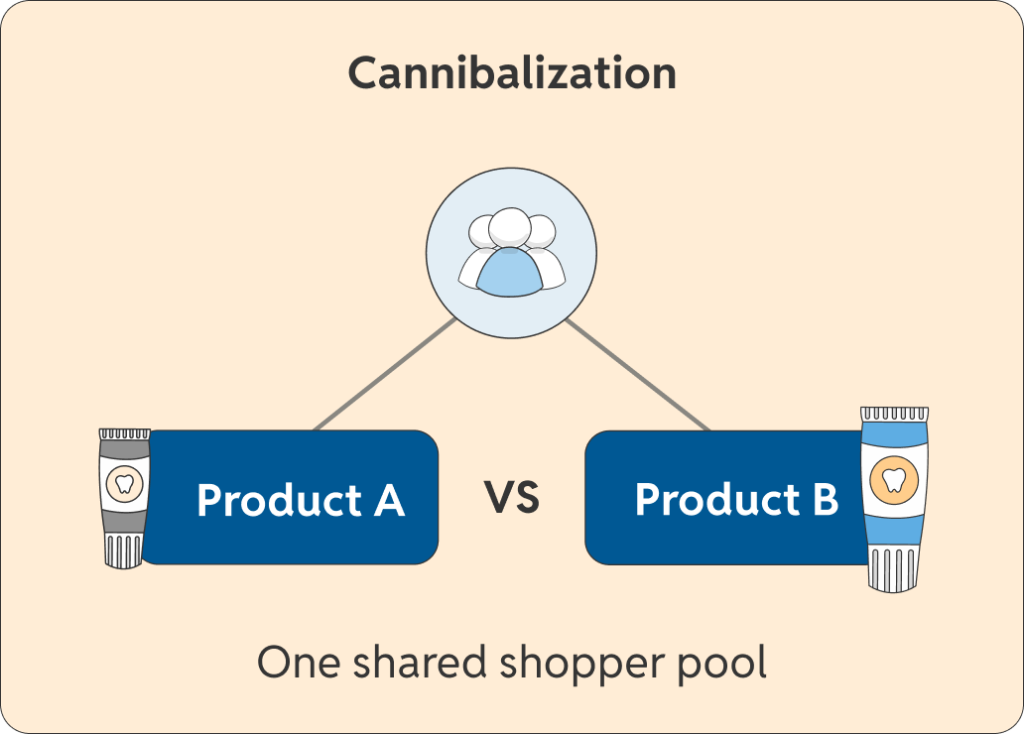
Internal cannibalization happens when a promotion or offer shifts demand from one of your products to another, instead of creating new demand. It represents internal planning conflict rather than competitor pressure. This differs from normal competition because sales simply move from a substitute item, a different week, or full price to a promo price, rather than generating fresh volume. Unlike external market-share threats from competitors, internal cannibalization is entirely within your control.
In a promotional plan, it typically manifests in four ways:
- Between products: a discount on one item draws share away from a close substitute.
- Between promotions: simultaneous offers divide the same target audience.
- Within a category: multiple SKUs are promoted together, leading shoppers to buy the cheapest option.
- Across related categories: a deal on an item reduces volume for an adjacent option, such as frozen versus fresh items.
|
Without cannibalization |
With cannibalization |
|
Promotions generate incremental demand |
Promotions shift existing demand |
|
Products complement each other |
Products compete for the same shoppers |
|
Incremental sales are stronger |
Incremental sales are overstated |
|
Promo investment creates more value |
Promo investment may dilute margin |
Why internal cannibalization is a problem for promo planning
When left unmanaged, cannibalization distorts how a retailer evaluates and plans promotions.
1. Inflated promotional performance:
A promotion can look like a clear win at the product level while contributing very little incremental value once cannibalized sales are subtracted out. If the team is only looking at “did units go up,” they’ll keep calling it a success.
2. Margin dilution:
Discounting several related products at once often means giving away margin on volume that was already going to happen, you’re funding a promotion without generating enough new revenue to offset it.
3. Poor promotion evaluation:
When cannibalized sales get counted as incremental, post-promotion reporting becomes unreliable. Teams start believing certain tactics work better than they actually do, which shapes future planning decisions in the wrong direction.
4. Conflicting promotional calendars:
Overlapping promotions inside the same category or between related items can create unnecessary internal competition, the plan is fighting itself.
5. Lost optimization opportunities:
Every dollar spent cannibalizing your own sales is a dollar that could have promoted a different product, run in a different week, or been priced differently to generate genuinely new demand.
The most common causes of internal cannibalization
1. Promoting substitute products at the same time
Products with similar use cases, similar pack sizes, or similar price points are natural substitutes. When two of them are discounted in the same window, shoppers simply pick the better deal, they aren’t going to buy both.
2. Overlapping promotions within a category
Even without direct substitution, multiple offers stacked in the same category compete for the same shopper attention and the same trip budget. The category as a whole doesn’t necessarily grow just because more items in it are on promotion.
3. Poor promotional timing
Promotions scheduled too close together, back-to-back weeks on the same item, or simultaneous deals on related items, tend to shift demand forward or sideways rather than create it. A shopper who would have bought next week buys this week instead; nothing new was generated.
4. Similar price points and discounts
When two products land at nearly the same promotional price, shoppers stop differentiating between them on value and start choosing whichever is more convenient or familiar. The promotion mechanics themselves erase the reason to pick one over the other.
5. Ignoring product relationships
Promotion plans are often built item by item without mapping which products are substitutes and which are complements. A plan that doesn’t account for those relationships is planning blind to its own biggest risk.
How to identify internal cannibalization in your promo plan
1. Map product and promotion relationships
Identify assortment products competing for the same demand by flagging:
- Substitutes (similar function, pack size, or price tier)
- Complementary products and items frequently in the same basket
- Products in the same category
- Products targeting similar shopper segments or price points
You must map cannibalization risk to manage it. Start simple by tagging top-selling SKUs to give planners a baseline check before finalizing a calendar.
2. Look for overlapping promotions
Once relationships are mapped, review the promotional calendar itself for overlap:
- Same-category promotions running simultaneously
- Same-brand promotions stacked in the same window
- Similar pack sizes discounted together
- Similar price points across competing items
- Simultaneous discounts on items serving the same shopper need
3. Compare incremental sales, not just promotional sales
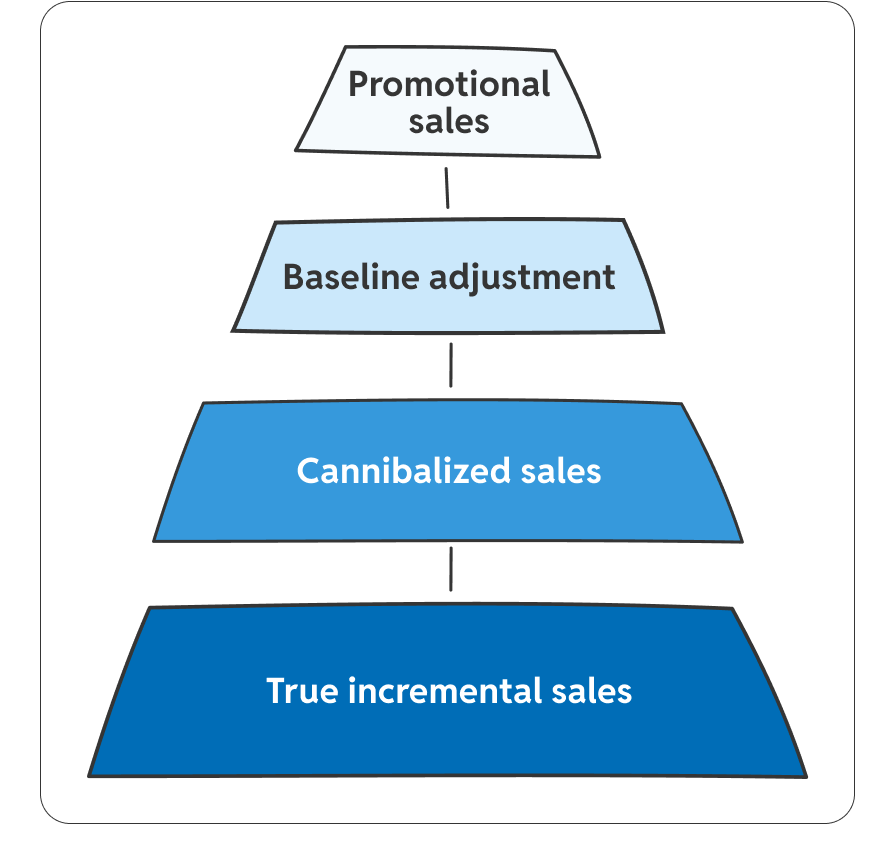
Promotional sales tell you what happened during the event. Incremental sales tell you what happened because of the event. The distinction matters:
- Total promotional sales: everything sold during the promo window
- Baseline sales: what would likely have sold anyway, without a promotion
- Incremental sales: the lift attributable to the promotion itself
- Cannibalized sales: volume that came at the expense of another product or period
A simple way to frame the relationship:
Incremental sales = Promotional sales – Expected baseline sales
4. Analyze category-level performance
Product-level results can be misleading on their own. Compare the two views side by side:
Product-level view: Product A +30%
Category-level view: Product A +30%, Product B -20%, Category +3%
The product-level number looks like a strong promotion. The category-level number tells you most of that lift came from somewhere else in the category, a classic sign of category cannibalization. Category-level analysis is what reveals whether demand actually grew or simply moved.
5. Compare similar promotions across time
Historical performance is one of the most underused tools for catching cannibalization before it repeats. Look back at:
- Similar products promoted together before
- Similar discount depths
- Similar timing patterns
- Similar shopper segments targeted
- Repeated promotional combinations
If a particular pairing has quietly underdelivered on incremental value in the past, that’s a pattern worth flagging before you repeat it, not after. This kind of historical view is a core part of any retail cannibalization analysis, and it gets more reliable the more promotion cycles you have to compare.
6. Use a cannibalization risk score
A simple scoring exercise can help planners flag high-risk combinations before a calendar is finalized. Consider scoring each promotion pair on factors such as:
- Product similarity
- Discount similarity
- Timing overlap
- Category overlap
- Shopper overlap
- Historical substitution behavior
How to measure the impact of product cannibalization
Once you suspect cannibalization, quantifying it turns a hunch into a decision.
Baseline comparison: Compare actual promotional sales against expected non-promotional sales for the same period, adjusting for seasonality and trend where possible.
Cross-product effects: Check whether another product’s sales dipped as the promoted product’s sales rose. A close, opposite-direction movement is the clearest signal of substitution.
Category-level incrementality: Ask whether the category as a whole grew, or whether growth in one item was offset by decline in another.
Margin impact: Unit lift alone doesn’t tell you if a promotion was worth running. You also need to weigh discount depth, promotional funding, margin rate, cannibalized volume, and genuine incremental demand together.
A practical retail cannibalization analysis framework
A five-step process you can apply to your next promotional calendar:
|
Step |
Key question |
What to analyze |
|
Identify |
What could compete? |
Product and category relationships |
|
Map |
Where does overlap occur? |
Calendar, pricing, shopper segments |
|
Measure |
What actually changed? |
Baseline, lift, category sales |
|
Simulate |
What could work better? |
Alternative scenarios |
|
Optimize |
Which plan creates the most value? |
Incremental sales plus margin |
- Identify which products and promotions are likely to compete for the same demand.
- Map those relationships across the calendar, pricing structure, and shopper segments.
- Measure actual performance against baseline and category totals, not just product-level results.
- Simulate alternative combinations before committing.
- Optimize for the plan that creates the most incremental value, not the one with the highest promotional sales number.
Tools and data that support retail cannibalization analysis
- Historical promotion data: reveals recurring patterns and past outcomes for similar pairings.
- Product hierarchy data: shows which items sit close together in category, brand, and pack-size structure.
- Transaction data: the raw signal for what shoppers actually bought and when.
- Pricing data: helps identify when promotional price points converge across substitute products.
- Promotional calendars: the single source of truth for what’s overlapping and when.
- Category performance data: the level at which true incrementality becomes visible.
- Customer or shopper data: helps identify when two promotions are targeting the same audience.
- Promotion forecasting: projects likely outcomes, including cannibalization risk, before a promotion runs.
- Scenario modeling: lets planners compare alternative calendar combinations before committing.
- Promotion optimization capabilities: help identify the combination of promotions likely to generate the most incremental value.
- AI-assisted analysis: can help surface overlap and substitution patterns across a large assortment faster than manual review allows.
FAQs
What is internal cannibalization in retail?
Internal cannibalization is when a product, promotion, or offer within a retailer’s own plan takes demand away from another product or promotion inside that same plan, rather than generating new demand for the business. It’s distinct from external cannibalization, which comes from competitors, and it’s largely controllable through better promotion planning.
What is product cannibalization?
Product cannibalization occurs when the sales of one product come at the expense of another product, often within the same retailer’s assortment. It commonly happens between substitute items, similar pack sizes, similar price points, or close category alternatives, when one is promoted and pulls demand away from the other.
How do you identify cannibalization in a promotion?
Compare product-level results with category-level results for the same period. If one item’s gains are roughly offset by another item’s losses, and the category total barely moved, that’s a strong signal of cannibalization. Reviewing the promotional calendar for overlapping offers on substitute products is the fastest way to spot the risk in advance.
What is retail cannibalization analysis?
Retail cannibalization analysis is the process of evaluating whether promotional or product-level sales gains represent genuinely new demand or simply demand shifted from elsewhere in the business. It typically involves comparing baseline sales, promotional sales, and category-level totals to separate real incremental value from internal sales shifting.
How does promotion cannibalization affect profitability?
Promotion cannibalization can erode profitability even when unit sales look strong, because the retailer is funding a discount on volume that would likely have sold anyway. The result is lower margin without a corresponding increase in real demand, the promotion looks successful on the surface while quietly destroying value underneath.
How can retailers prevent product cannibalization?
Retailers can reduce cannibalization risk by mapping substitute and complementary relationships across their assortment, avoiding unnecessary overlap between similar promotions, assigning distinct roles to different products in the calendar, and testing alternative promotional scenarios before committing to a final plan.
Can two promotions run at the same time without causing cannibalization?
Yes. Promotions on complementary products, or on items targeting different shopper needs, can run simultaneously without competing for the same demand. The risk arises specifically when the two promoted items are close substitutes, similar function, price point, or shopper appeal, during the same window.