Every major enterprise software category in retail, pricing, assortment, supply chain, promotion, was built to solve a specific set of problems. Each system got better at its domain over time. Each accumulated expertise, data, and logic that made it increasingly valuable within its area of responsibility.
But retail decisions don’t stay neatly inside one system. A category review touches pricing, promotion, assortment, and inventory all at once. A merchant trying to improve performance needs answers that span the entire technology stack, and today, getting those answers usually means moving between systems, pulling separate analyses, and reconciling recommendations that were never designed to work together.
AI agents are about to change how that works. Not by replacing specialized systems, but by giving them a new way to contribute their expertise to decisions that extend beyond any single application.
This is where the Cora AI Agent fits into the bigger picture, and why it matters for how retailers think about the future of their enterprise AI strategy.
Business questions across application boundaries
For decades, enterprise applications have exchanged information through integrations, flat files, APIs, event-driven feeds. These connections enable systems to share data and support defined processes. They’re essential, and they’ll remain essential. But they were designed to move structured information, not to answer open-ended business questions.
Consider what happens when a merchant asks a question like this:
The question no single system can actually answer
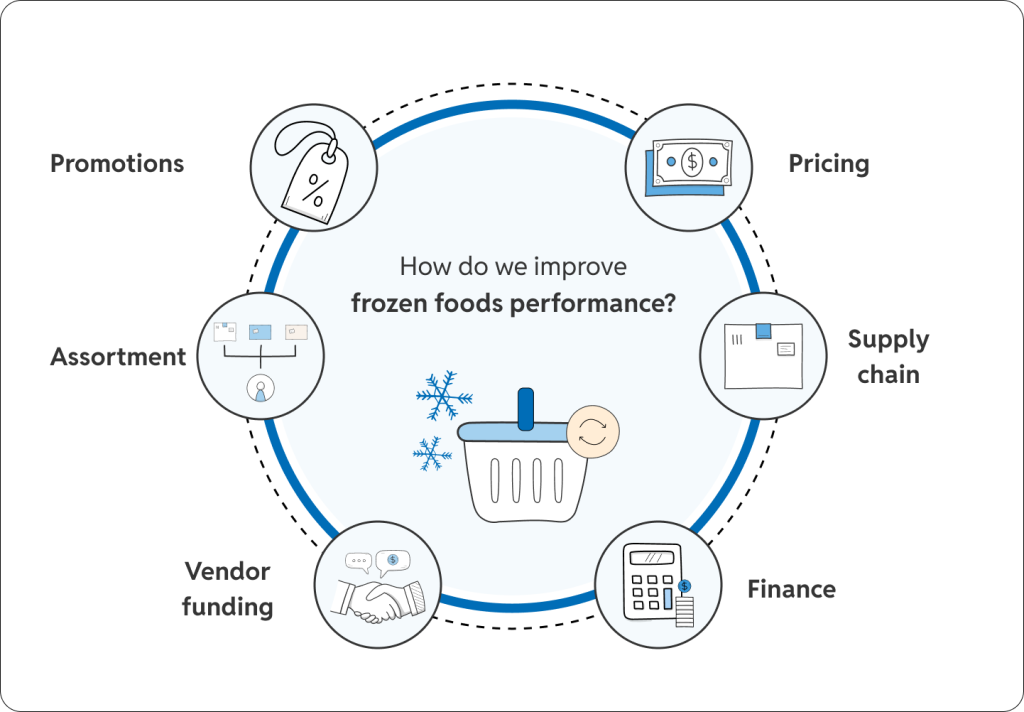
“How can we improve performance in our frozen foods category over the next quarter?”
That isn’t a promotion question. It isn’t a pricing question. It isn’t an assortment or supply chain question. It’s a business question, and answering it well requires understanding how all of those domains interact.
The pricing strategy affects what promotions can realistically achieve. The assortment determines where the real opportunity lies. Inventory constraints set the ceiling on what demand can actually be fulfilled. Vendor funding shapes what’s financially viable. No single application holds the complete picture, and no traditional integration was designed to synthesize across all of them in real time.
This is the gap that AI agents, working together, are uniquely positioned to close.
How specialized agents work together: The frozen food example
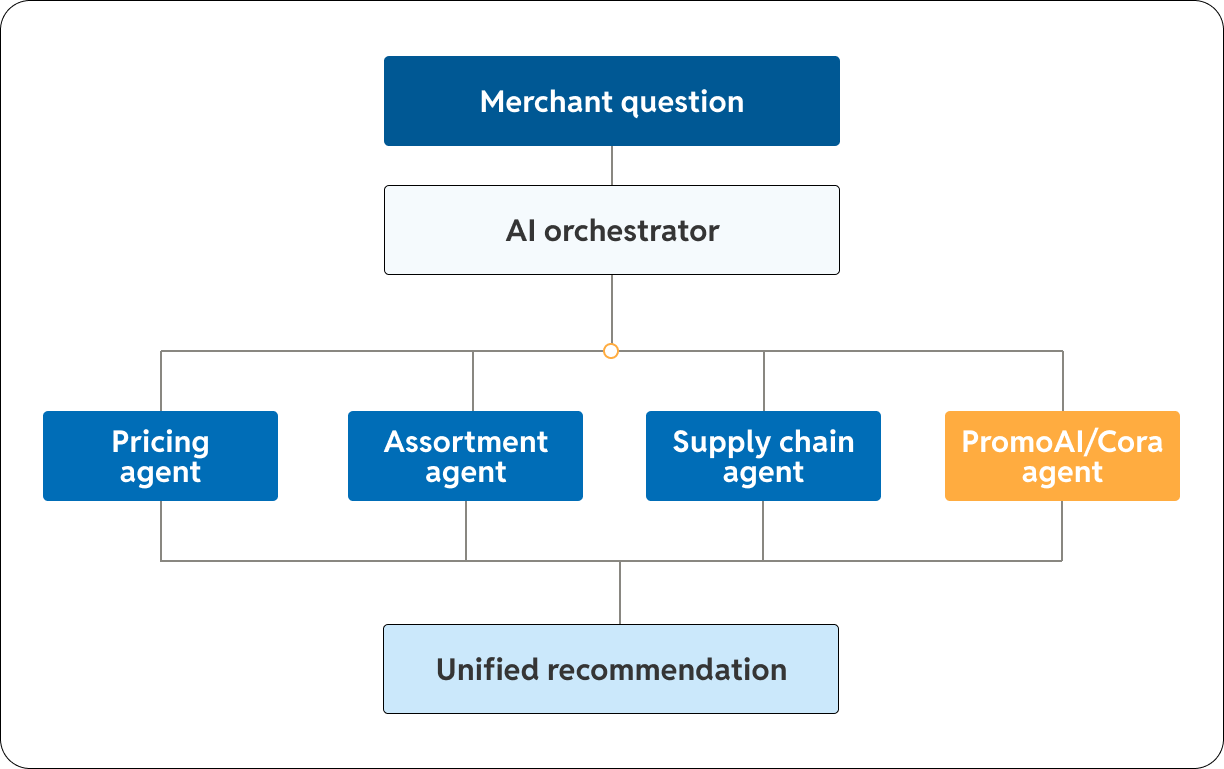
To understand how this works in practice, return to the merchant’s question about frozen foods. In an enterprise AI ecosystem built on specialized agents, an orchestrating agent routes the question to each relevant domain and asks for that domain’s perspective.
Each agent contributes what it knows best
|
Pricing Agent Competitive position & Price elasticity analyzes competitive position and price elasticity. Since key items are already competitively priced, further price investment alone won’t materially improve category performance. |
Assortment Agent Product mix & Private label identifies low private-label penetration in several high-growth segments and highlights opportunities to adjust the product mix. |
|
Supply Chain Agent Inventory & availability risk flags inventory constraints on several high-volume frozen appetizers, indicating that increased promotional demand could create availability risks. |
Cora, PromoAI Promotion planning expertise Using PromoAI’s forecasting, optimization, analytics, and vendor funding, Cora analyzes recent promotions, tests strategies, and finds funding opportunities to enhance future promotional performance. |
The orchestrator then brings those perspectives together into coordinated guidance for the merchant. The merchant receives one coordinated view of the category, not a collection of disconnected analyses to reconcile manually. Each agent contributes what it knows best and the orchestrator helps the business understand how those recommendations and constraints fit together.
Coordinated guidance: what the merchant receives
- “What would happen if I ran a Buy One Get One promotion on our own brand of hot-dogs for Fourth of July?”
- “Why is forecasted lift lower than expected?”
- “What happens if I increase vendor funding?”
- “Would a 3 for $10 offer perform better?”
A new integration pattern for enterprise software
None of the applications in this example replaces another.
Pricing applications remain responsible for pricing. Supply chain systems continue to manage inventory and replenishment. PromoAI remains the system of expertise for promotion planning. What changes is how their expertise becomes available to the broader business.
|
Traditional integration Systems share data
|
AI agent integration Systems share expertise
|
Traditional integrations will continue to exchange structured data and support defined business processes. AI agents complement those mechanisms by allowing applications, and other agents, to request analysis, explanations, recommendations, and domain-specific guidance on demand.
The retailer’s orchestrator does not need to contain PromoAI’s promotion planning expertise. It needs to understand when that expertise is relevant and how to engage Cora. Likewise, Cora does not need to become an expert in assortment or replenishment. She contributes PromoAI’s perspective while relying on other specialized agents to represent their own domains.
This agent-to-agent model allows retailers to bring together expertise from across their technology landscape while retaining control over which agents participate, what information they can access, and how their contributions are coordinated. In this model, Cora serves as the AI interface through which PromoAI contributes its promotion planning expertise to the retailer’s broader enterprise ecosystem.
Looking ahead
Enterprise applications will continue to manage data, workflows, and transactions. AI agents give those applications another way to participate in the business, by contributing expertise to decisions that extend beyond a single system or function.
As agent-to-agent ecosystems become part of the enterprise architecture, applications will increasingly be valued not only for the processes they support, but for the specialized knowledge they can contribute to broader business decisions. The retailers who will be best positioned aren’t necessarily those who deploy the most AI the fastest. They’re the ones who think about each AI investment as part of a broader ecosystem from the start.
“The opportunity is not to build one AI that attempts to understand every part of retail. It is to create an ecosystem of specialized agents that work together, helping business users make better, faster, and more coordinated decisions across disciplines.”
-DJ O’Neil, VP of Product, Cognira
Cora is Cognira’s commitment to that direction. Built on PromoAI’s depth of promotion planning expertise, she’s designed not only to help planners work more effectively today, but to serve as PromoAI’s intelligent interface to the broader enterprise AI landscape as that landscape matures.